WFSW Newsletter – Summer 2026

FMTS-WFSW Newsletter
Summer 2026
Welcome
Science across borders: cooperation in action
Science has always crossed borders. Knowledge grows through exchange, dialogue and cooperation — between researchers, institutions, countries and generations. At a time of conflict, growing inequalities and global challenges, these connections are more important than ever.
Over the past three months, the WFSW has continued to turn this principle into action. From its engagement with UNESCO on water security and sustainable development to new international partnerships, the defence of academic freedom and initiatives promoting peace, the Federation has strengthened spaces for dialogue and cooperation among scientific workers and civil society.
These activities reflect a conviction that lies at the heart of the WFSW: science cannot fulfil its role in society in isolation. It requires freedom, international cooperation and the participation of those who produce and use knowledge. It also requires a commitment to ensuring that scientific progress contributes to peace, social justice and a sustainable future.
In this Summer issue, we look back at some of the initiatives that marked May, June and July 2026 — bringing together global dialogue and local action, established partners and new connections, scientific knowledge and social responsibility.
Across borders, science connects us. Cooperation turns that connection into action.
_________________________________
Science, Peace and Cooperation
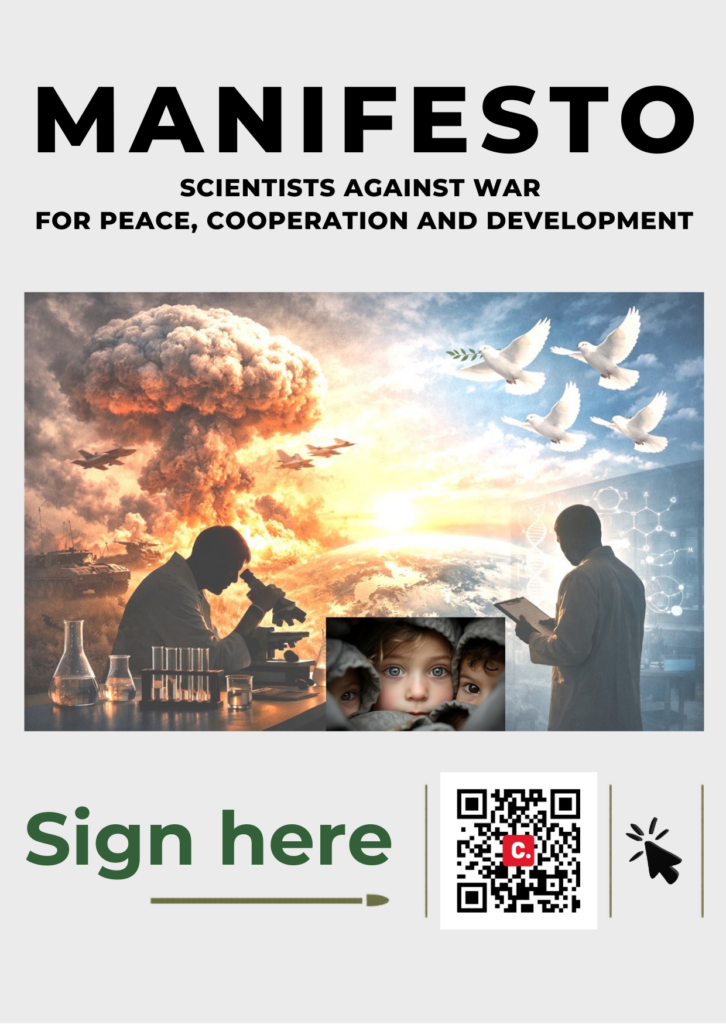
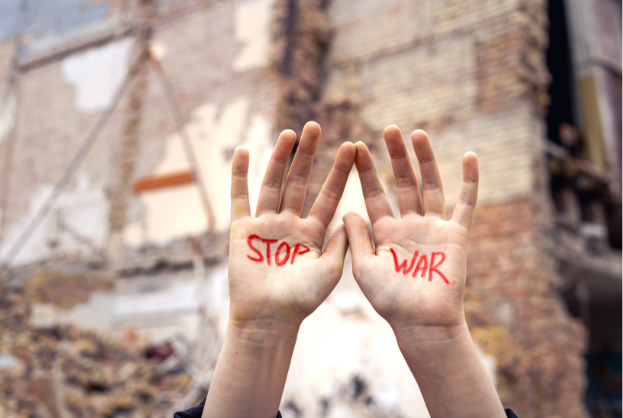
The scientific community must rise against war
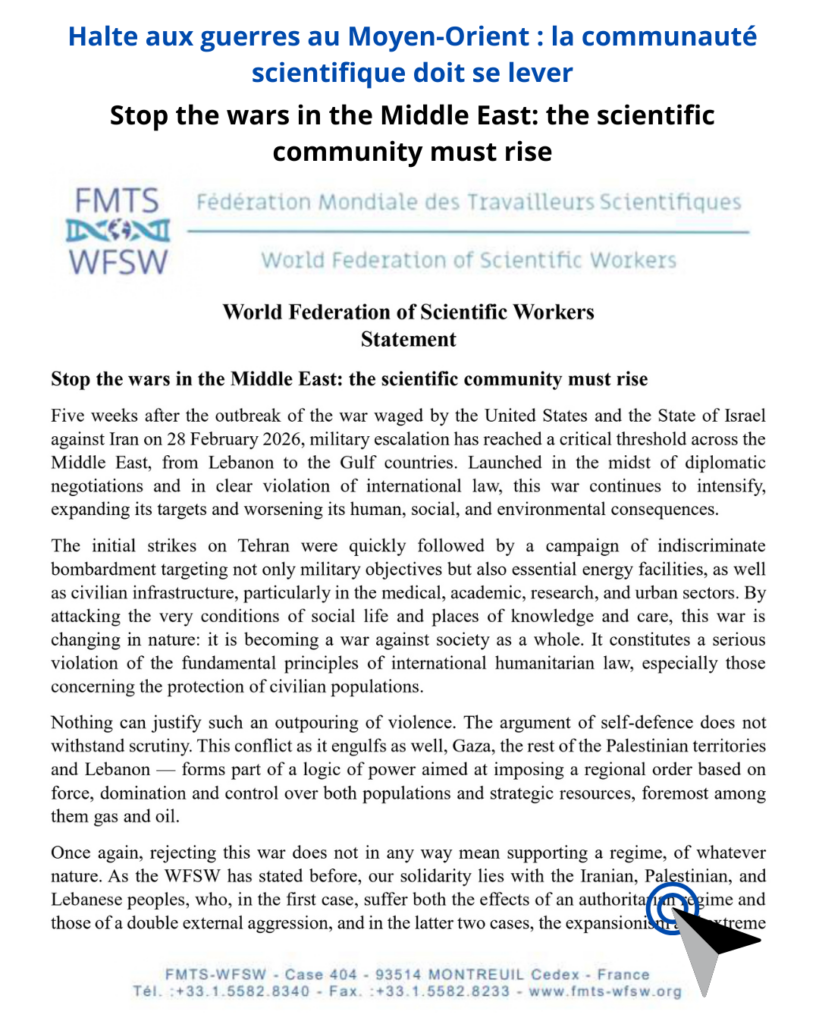
In its statement “Stop the wars in the Middle East: the scientific community must rise”, published on 26 May, the WFSW called on scientists, researchers and scientific institutions worldwide to speak out against war and to defend international law, dialogue and peaceful solutions.
The statement draws attention to the direct consequences of armed conflict for science. When universities, hospitals and research infrastructures are destroyed, the production and sharing of knowledge are also threatened. War undermines scientific cooperation itself — a cooperation built on exchange, trust and universality.
At a time when humanity faces challenges that no country can address alone, the WFSW stresses the need for cooperation, shared knowledge and solidarity. Defending peace therefore also means preserving the conditions that allow science and international scientific cooperation to flourish.
Science should bring people together, not be placed at the service of division and destruction.
_________________________________
WFSW & UNESCO — From proposal to action
Water as a Common Good: turning dialogue into cooperation
On 16 July, the WFSW organised the round table “Water as a Common Good: Local Resilience and Sustainable Development” at UNESCO Headquarters in Paris, as part of the 2026 Global Conference of the International Decade of Sciences for Sustainable Development (2024–2033). The event marked the culmination of several months of preparation following the selection of the WFSW proposal for the Conference’s thematic programme.
Bringing together researchers, representatives of civil society and UNESCO-affiliated NGOs, local communities and journalists, the round table explored one of today’s most pressing challenges: how to preserve water as a common good while ensuring fair and sustainable access to it. Experiences from Morocco, France and other regions connected the global debate with realities on the ground, addressing water scarcity and pollution, environmental justice, community resistance and the impact of climate change, urbanisation, intensive agriculture, industry and tourism.
The discussion gave particular attention to the social and human dimensions of water governance. Participants highlighted the disproportionate impact of water insecurity on women and children and the persistent inequalities affecting women’s participation in decisions about water, despite the central role they often play within their communities.
The round table concluded with a clear set of shared principles: access to water is a universal human right; women must be both beneficiaries and decision-makers; water stress is not only a consequence of climate change but also of failures in governance; and water use must prioritise fundamental human needs and the preservation of ecosystems. Participants also stressed that democratic, transparent and participatory governance is essential to safeguarding the right to water in the long term.
The dialogue also led to concrete cooperation. On the sidelines of the event, the WFSW signed two Memoranda of Understanding: one with the coalition supporting the women of the Figuig Oasis in Morocco, represented by Samira Mizbar, and another with Coordination Eau Île-de-France, represented by Jean-Claude Oliva. The first aims to support the preservation of the community’s springs and their recognition as common heritage. A further agreement between BPW International and the Global Institute/UNESCO Chair “Eau, femmes et Gouvernance” opened additional opportunities for cooperation around gender equality and sustainable water governance.
From scientific knowledge to local experience, and from dialogue to partnership, the initiative showed how international scientific cooperation can help turn shared challenges into collective action.
_________________________________
Recognition — Advancing a Culture of Peace in Africa
Women, water and peace: international recognition for a WFSW initiative
In July, the WFSW initiative “Women’s Engagement in Morocco for Water and Education as a Factor of Security and Peace” was recognised as a contribution to Advancing a Culture of Peace in Africa, within the joint initiative of UNESCO’s Division for Priority Africa Coordination and the NGO–UNESCO Liaison Committee.
The initiative brings together issues that are closely connected but too often addressed separately: access to water, women’s participation, education, security and peace. Its recognition also places the WFSW within a broader effort to identify and connect civil society initiatives working to strengthen a Culture of Peace across the African continent.
As part of this recognition, the WFSW was authorised to use the NGO–UNESCO Liaison Committee Label of Designation for Promoting a Culture of Peace in Africa 2026 for the initiative. The wider process aims to give greater visibility to recognised projects, encourage the exchange of good practices and create new opportunities for dialogue and cooperation among civil society organisations and partners.
For the WFSW, the recognition reinforces a central message: sustainable development, gender equality and peace are deeply interconnected — and cooperation can help turn that connection into action.

_________________________________
A new international partnership — WFSW & CAST
Building new bridges for scientific cooperation
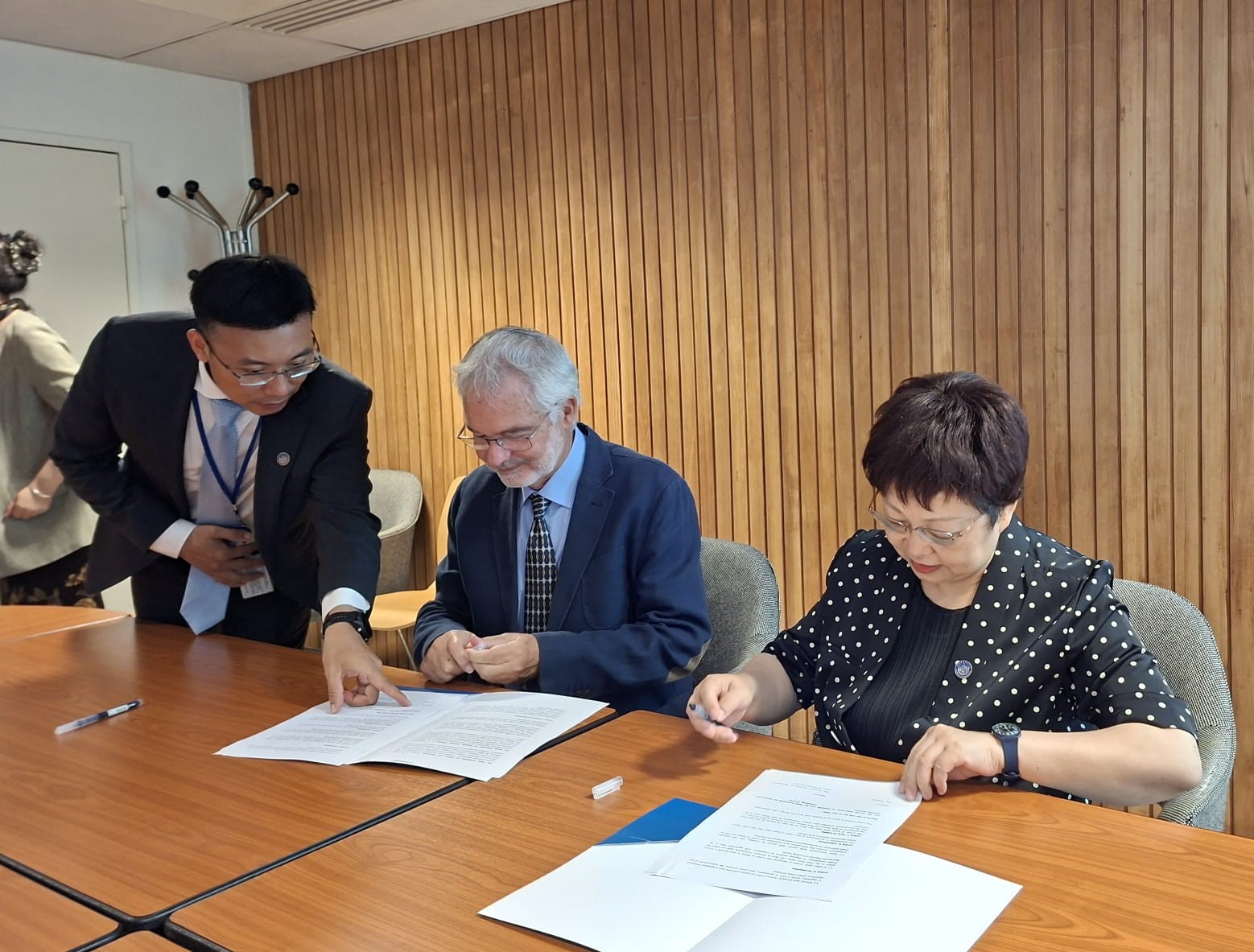
On 16 July, the WFSW and the China Association for Science and Technology (CAST) took an important step towards closer cooperation with the signing of a Letter of Intent for Cooperation at UNESCO Headquarters in Paris.
The agreement followed a period of exchanges between the two organisations and establishes a basis for developing their relationship and exploring future opportunities for joint initiatives. The process was supported by the WFSW China Secretariat, hosted by the China Centre for Science and Technology Exchange of CAST, which played an important role in facilitating contacts between the two organisations.
The WFSW delegation brought together Elies Molins, Josette Rome-Chastanet, Najat Tahani, Mehdi Lahlou and Pascal Janots, reflecting the Federation’s commitment to strengthening its international connections and creating new opportunities for scientific exchange and cooperation.
The new partnership opens the way for further dialogue and collaborative initiatives between the WFSW and CAST, connecting scientific communities across countries and reinforcing the role of international cooperation in addressing shared challenges.
For the WFSW, the agreement represents another step towards turning international dialogue into lasting cooperation — and building new bridges between scientific workers around the world.
_________________________________
Defending Academic Freedom
A professional right, a public good
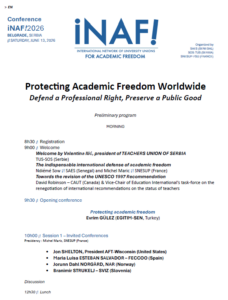
On 13 June, the WFSW contributed to the international conference “Protecting Academic Freedom Worldwide — Defend a Professional Right, Preserve a Public Good” in Belgrade, bringing together organisations and representatives from different countries to discuss the growing pressures on academic freedom and the conditions needed for independent scientific and academic work.
Aymen Bouali (Tunisia), representing the WFSW and participating remotely, presented an analysis of the Academic Freedom Index, contributing to a broader discussion that addressed challenges ranging from restrictions on academic communities and the situation of women academics to the commercialisation of higher education, trade union rights and the impact of artificial intelligence.
In its message to the conference, the WFSW reaffirmed that academic freedom is part of universal rights and that its defence concerns not only academics and students, but society as a whole. Freedom, democracy, exchange and cooperation are essential both to scientific practice and to human development.
At a time when scientific and academic communities face increasing pressures in many parts of the world, protecting the freedom to research, teach, question, debate and exchange knowledge remains fundamental to the social responsibility of science.
Defending academic freedom means defending the conditions in which knowledge can be created, shared and placed at the service of society.
_________________________________
Young Scientists — What happened next?
New voices, new connections
In our May Newsletter, we asked: who are the next voices shaping the future of science? Over the following months, that conversation continued within the WFSW, with new steps towards strengthening the participation and connections of young scientific workers across the Federation.
For Chaimaa Haoufazane (Morocco), whom we introduced in May as a young chemist and member of WG8 — Young Scientists, this period also marked an important personal milestone: the completion of her PhD. At the same time, she continued her involvement in the WFSW, helping to reconnect young members and exploring ways to broaden participation in WG8.
Another academic milestone came from Senegal, where Salma Sylla, a member of AFSTech, successfully completed her PhD. Her achievement adds another young scientific voice to the growing network of researchers connected through the Federation.
Contacts with young scientific workers from different WFSW member organisations are helping to create new connections across countries and regions. There is also growing interest in building links between WG8 — Young Scientists and WG5 — Women and Science, bringing together two dimensions that are particularly important for the future of scientific work: generational renewal and equal participation.
These are still early steps, but they point towards an important objective: creating more space within the Federation for young scientific workers to meet, exchange experiences, develop initiatives and contribute their own perspectives to the WFSW’s work.
The future of the Federation will also be shaped by its ability to connect generations — giving new voices the space not only to participate, but to help define what comes next.
_________________________________
Affiliates in Action
From national initiatives to shared challenges
Across the WFSW, affiliated organisations bring global concerns into national and local debates. From the future of scientific systems to the defence of public universities, their activities show how many of the challenges facing scientific workers today cross borders — even when they take different forms in different countries.
OTC · Portugal
What future for science and research?
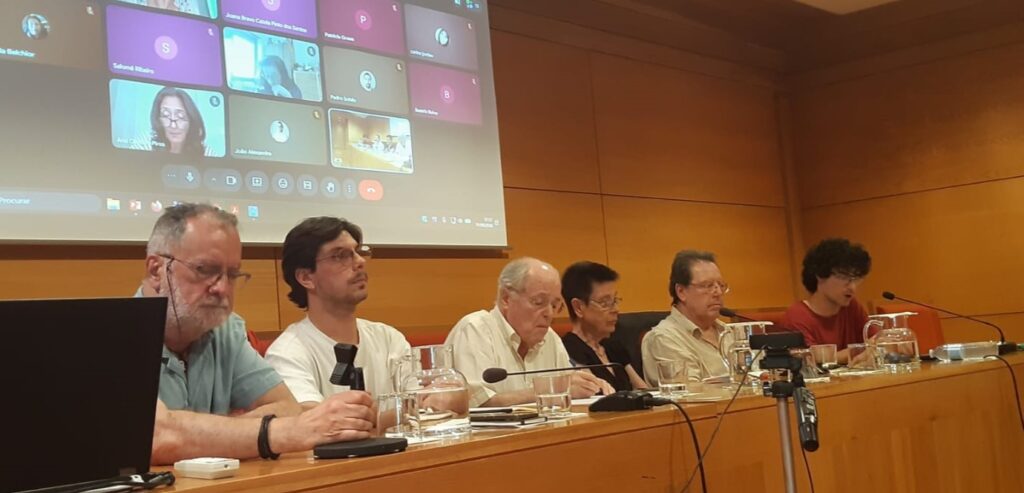
On 24 June, the Organização dos Trabalhadores Científicos (OTC) took part in organising the round table “AI²: from its creation to what it promises — a critical analysis”, held at the Institute of Social Sciences of the University of Lisbon.
The debate examined the creation of Portugal’s new Agency for Research and Innovation (AI²) and the implications of this major reform of the national scientific system. Speakers discussed questions including scientific autonomy, research funding, bureaucracy, the balance between fundamental research and economically oriented innovation, and the continuing precariousness of scientific careers.
Bringing together researchers from different disciplines and organisations, the initiative created a space for critical discussion about a question extending well beyond institutional reform: what kind of scientific system is needed to serve knowledge, scientific workers and society?
Read more about the AI² round table →
FESIDUAS · Argentina
Standing up for public universities and science
In Argentina, FESIDUAS — Federación de Sindicatos de Docentes Universitarios de América del Sur joined a series of initiatives in defence of public universities, scientific research and the conditions of those who work within them.
On 12 May, FESIDUAS joined other education and scientific workers’ organisations in supporting the Marcha Federal Universitaria, calling for adequate funding for public higher education and the effective implementation of the University Financing Law.
The mobilisation continued over the following months, amid concerns over funding cuts, job losses and the deterioration of the country’s scientific and technological capacities. In July, FESIDUAS was among the organisations supporting a debate on proposed legislation aimed at ensuring the sustainability and protection of Argentina’s National System of Science, Technology and Innovation, bringing together representatives from the scientific, technological, university, trade union and political communities.
From defending public universities to strengthening the protection of the national science and technology system, these initiatives reflect a broader commitment to safeguarding scientific capacity, public knowledge and the people whose work sustains them.
Read more about the Marcha Federal Universitaria →

Mobilisation in defence of public universities in Argentina
Different countries, different contexts — but shared questions about the future of science, higher education and scientific work. Across the Federation, affiliated organisations continue to turn these concerns into debate, mobilisation and action.
_________________________________
Working Groups — Preparing the next chapter
The WFSW Working Groups are entering a new phase as the Federation develops its Strategic Plan 2026–2030. The ongoing work aims to strengthen the groups, clarify their objectives and roadmaps, broaden participation and better connect their activities with the Federation’s strategic priorities.
New areas of work are also being explored, including proposals for groups dedicated to Public Services and Cooperation and Science, Digital and Democracy, alongside the strengthening and possible evolution of existing Working Groups.
The process also provides an opportunity to encourage greater involvement from WFSW members and affiliated organisations, bringing new expertise, perspectives and ideas into the Federation’s work.
More on the WFSW Working Groups — their role, current activities and future directions — in a forthcoming issue of the Newsletter.
_________________________________
May–July at a glance
Three months of decisions and preparation
Alongside the international initiatives highlighted in this Newsletter, the WFSW continued to advance several important areas of its internal and strategic work.
4 May — International Secretariat
The International Secretariat unanimously approved the draft revision of the WFSW Statutes and reviewed progress on the Strategic Plan 2026–2030. Discussions also addressed the future of the Working Groups, including the need to strengthen participation and the proposal for a new group dedicated to Public Services and Cooperation.
May — Working Groups and Communication
WG6 and WG7 continued work on the Federation’s Rules of Procedure and Strategic Plan, while the Communication Sector developed new ways of strengthening the WFSW’s visibility and giving greater space to affiliated organisations in the Federation’s communication activities.
1 June — Preparing the Federation’s next phase
The International Secretariat reviewed the evolving Strategic Plan as a working document open to further contributions and discussed revisions to the Rules of Procedure, as preparations continued for the next institutional cycle of the Federation.
June–July — 24th General Assembly postponed
Following extensive discussion of organisational, logistical and financial constraints, the International Secretariat approved the postponement of the 24th WFSW General Assembly, originally scheduled for the beginning of September in Mexico. The Assembly is now expected to take place in February 2027, allowing additional time for preparation and broader participation.
Behind these developments, regular meetings of the Bureau, Working Groups, sectors and International Secretariat continued to coordinate the Federation’s work and prepare its next strategic and organisational steps.
_________________________________
Looking Ahead
Shaping the next steps together
The months ahead will mark an important transition for the WFSW as the Federation prepares its next strategic and organisational cycle.
Work will continue on the WFSW Strategic Plan 2026–2030, bringing together priorities for the coming years and considering how the Federation, its Working Groups and affiliated organisations can work more effectively together. Strengthening participation, international cooperation and the capacity to turn shared priorities into concrete initiatives will be central to this process.
Following the decision to postpone the 24th WFSW General Assembly, originally planned for September in Mexico, preparations will continue towards its expected organisation in February 2027. The additional time provides an opportunity to strengthen participation, further develop the programme and prepare the decisions that will shape the Federation’s next cycle.
The WFSW will also continue to create opportunities for a new generation of scientific workers. As an official partner of UNESCO, the Federation has been invited to submit nominations for the UNESCO–Al Fozan International Prize for the Promotion of Young Scientists in Science, Technology, Engineering and Mathematics (STEM), with the next nomination deadline in November 2026.
Learn more about the 2026 call for nominations →
As the WFSW looks towards its next chapter, its strength will continue to depend on the ideas, experience and active participation of its members and organisations around the world.
Glossary
WFSW World Federation of Scientific Workers
FMTS Fédération mondiale des travailleurs scientifiques
UNESCO United Nations Educational, Scientific and Cultural Organization
CAST China Association for Science and Technology
OTC Organização dos Trabalhadores Científicos
FESIDUAS Federación de Sindicatos de Docentes Universitarios de América del Sur
AFSTech Association des Femmes Sénégalaises des Technologies
BPW International International Federation of Business and Professional Women
AI² Agência para a Investigação e Inovação (Portugal)
NGO Non-Governmental Organization
WG Working Group
STEM Science, Technology, Engineering and Mathematics
Editorial Board
WFSW Communication Sector
Editorial coordination: Joana Santos & Sylviane Lejeune
Editorial review: Frederico Carvalho (Vice-President of the Executive Council)
French translation: Florence Lejeune
Institutional validation: Jean-Paul Lainé & Elies Molins (Co-Presidents)
Get involved
Send your news, events and reports for inclusion in a future issue of the Newsletter to:
communication@fmts-wfsw.org
FMTS-WFSW • fmts-wfsw.org
You are receiving this email because you are on our distribution list
Follow WFSW