THE UNITED NATIONS
THE UNITED NATIONS: SIGNS OF GROWING IRRELEVANCE
Frederico Carvalho and Mehdi Lahlou
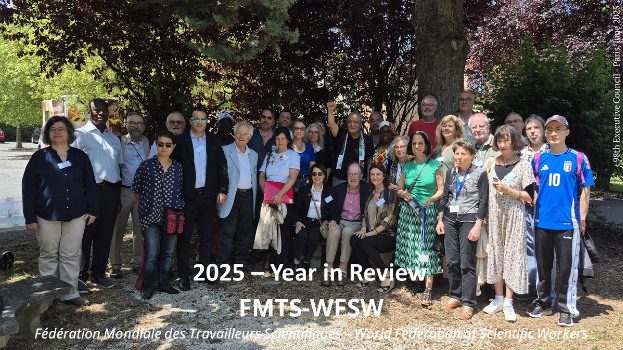
98th Executive Council Meeting of the World Federation of Scientific Workers
Paris, France, June 9–13, 2025
A Contribution to the debate within
Working Group 1: “Peace, Development and Cooperation”
Created in the aftermath of the Second World War to preserve global peace and promote international cooperation, the United Nations now appears increasingly marginalised and utterly powerless in the face of today’s major challenges. Far from the founding momentum of 1945, the organisation is now plagued by three intertwined crises: of legitimacy, effectiveness, and representativeness.
Several developments converge to support this deeply concerning observation.
1. Powerlessness in the face of major conflicts
Whether it is the war in Ukraine, the war in Gaza, and the broader Israeli–Palestinian conflict, or the recent tensions between India and Pakistan, the UN is no longer able to prevent wars, impose lasting ceasefires, or restore peace. The Security Council, paralysed by the veto power of major nations—first and foremost the United States and the Russian Federation—has become a stage for sterile diplomatic showdowns and, at times, provocative posturing by states involved in bloody conflicts.
Resolutions, painstakingly negotiated, are often blocked, stripped of their substance, or ignored on the ground. This systematic deadlock has ultimately turned the UN into a mere spectator of the tragedies it was meant to help stop, if not prevent.
2. A crisis of representativeness
The UN’s current structure reflects a world order dating back to 1945, one that is now clearly outdated. The lack of permanent representation for entire regions—particularly Africa, Latin America, and the Arab-Muslim world—on the Security Council undermines the legitimacy and potential effectiveness of its decisions.
This configuration perpetuates a geopolitical imbalance in which the interests of the Global North continue to outweigh those of the Global South, which are often sidelined in major international negotiations. This fuels a damaging double standard, at odds with international law, which is supposed to be based on the principle of equality between nations, regardless of their demographic or economic weight.
3. Ineffectiveness, even impotence, in the face of global emergencies
When it comes to planetary challenges – climate crisis, pandemics, social inequalities, forced migration, nuclear threats, disarmament – the UN is slow, fragmented, and often limited to declarations of intent without binding measures, and therefore without impact.
The major climate conferences (COPs) are a clear example: painstakingly reached agreements, unfulfilled commitments, insufficient funding, often promised, rarely delivered. Likewise, disarmament efforts are stalling – or even regressing – while nuclear arsenals are being modernised and engagement doctrines are becoming
increasingly opaque and threatening.
4. Bureaucratisation and the loss of influence across the board
The organisation has become a vast, sometimes opaque, bureaucratic apparatus, open to accusations of waste, inefficiency, and even complacency towards certain authoritarian regimes.
On the ground, UN agencies are often constrained by limited mandates or dependent on the goodwill of specific member states, chiefly the United States of America and the Russian Federation. The result is a significant loss of credibility among the very populations that expect real protection from it.
Should we then abandon the idea of the UN?
Not necessarily. For the UN’s failings stem not so much from its founding principles as from how states manipulate or exploit the institution to serve their interests—or those of their allies.
It remains the only truly universal forum for dialogue between nations, a space where international law, however flawed, continues to be developed. Its specialised agencies WHO, UNESCO, FAO, UNDP, UNHCR, and others- still play a vital role in many areas: culture, education, poverty reduction, hunger eradication, epidemic control, and more.
However, a profound overhaul of its structure and functioning is now essential. Some possible reforms include:
• Reforming the Security Council to include more countries from the Global South and to limit or suspend the veto power, particularly in cases of mass atrocities or acts defined by the International Criminal Court as genocide;
• Strengthening the financial autonomy of the UN and its agencies, to reduce dependence on major powers;
• Making international commitments binding and irrevocable—especially regarding climate, peace, and human rights;
• Increasing the involvement of global civil society, and particularly scientists from all disciplines, in UN governance, to break free from the purely state-centric diplomatic deadlock.
All this suggests that it is essential to invent – or reinvent – a system of global governance truly based on law and justice. Criticism of the UN should not fuel fatalism or nationalist retreat, but rather pave the way for an ambitious transformation of multilateralism, with the collaboration of all, particularly scientists working for peace. In the face of global existential threats, humanity needs strong, democratic, and credible global institutions. The alternative is not less UN, but a better UN, or, failing that, new international institutions genuinely capable of upholding peace, social justice, and human survival in the face of ecological challenges.
Mehdi Lahlou & Frederico Carvalho
26 May 2025
________________________________________________________________________________
Graphic composition: OTC, Portugal
Portuguese version: https://otc.pt/wp/2025/09/13/em-defesa-da-onu/