The Role of Art in the Culture of Peace
International Conference Highlights the Role of Arts and Education in Building Peace
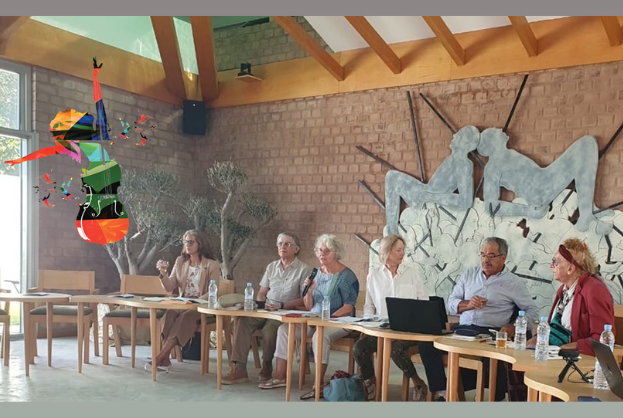
27 September 2025 – Under the patronage of the French National Commission for UNESCO, the Collective of NGOs in Official Partnership with UNESCO organised the international conference “Arts, Education, and Youth for a Culture of Peace”, dedicated to reflection on the contribution of arts and education to the promotion of a culture of peace. The event took place in a hybrid format, with participants gathered in Rabat, Gaza, Lyon, and Jeju, and featured interventions from representatives of various civil society organisations and UNESCO partner institutions.
The opening session was moderated by Marie-Claude Machon-Honoré, coordinator of the NGO Collective for Peace, and included the participation of Vithmiru Stoyanova, president of the NGO-UNESCO Liaison Committee, and Nisrine Nadjil, executive secretary of the same Committee, who presented the priorities of the 2025–2026 work programme, focused on strengthening partnerships, empowering young people, and collaborating with UNESCO programmes.
Representing the French National Commission for UNESCO, Alexandre Navarro emphasised the essential role of NGOs in mobilising for peace, human rights, and education, highlighting the need for coordinated action between institutions, states, and civil society.
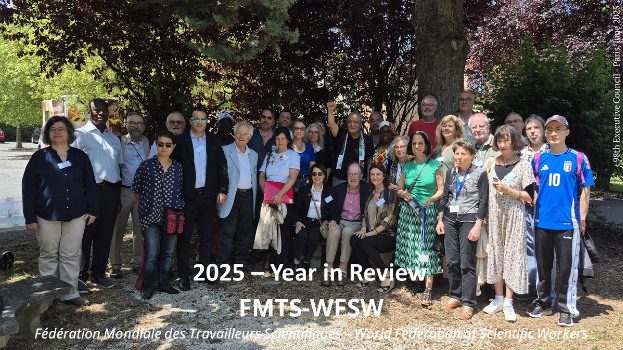
The World Federation of Scientific Workers (WFSW) was represented by Mehdi Lahlou, associate professor at Mohammed V University (Rabat, Morocco), and Bonaventure Mvé-Ondo, Emeritus Professor at Omar Bongo University (Libreville, Gabon), members of the Federation, who highlighted the importance of culture, art and education in building peace. Mehdi Lahlou, speaking from Rabat, emphasized that dance is not merely entertainment, but a means of communication between different communities, a space for encounter and collective healing. We organise this journey to affirm that dance, song, and culture can be true instruments of mass pacification — weapons of peace through movement, through gesture, and through the word.
The video “Dance and Shared Peace 2024”, produced by Claude Yvans, was presented, illustrating cultural and artistic experiences that promote peace.
Professor Bonaventure Mvé-Ondo led an academic reflection on “Rethinking Peace in a World in Crisis”, highlighting three fundamental paths – truth, culture and education – and asserting that peace is not merely the silence of weapons, but the most demanding form of shared justice and restored dignity.
Other notable testimonies and contributions included:
- The Palestinian troupe Al-Fursan, presented by Bachar El Belbezi and Sabrina Boucousselier, describing their artistic action in a war context as an act of resistance and hope;
- Hussein Ngoy Ndala, president of the Parliament of the Youth of the Democratic Republic of Congo, on the role of art as an instrument of reconciliation and dialogue;
- Sophie Maréchal, from the association ATD Quart Monde, with the Festival of Knowledge and Arts in Lyon;
- Matteo Corbucci, president of OMEP-Italy, an association for social promotion representing the National Committee of the World Organisation for Early Childhood Education (OMEP), emphasising the importance of creative education from early childhood;
- Gloria Ramirez, president of the International Association of Educators for Peace (IAEP), stressing the role of women in consolidating peace and defending human rights.
The conference also highlighted the artistic and historical testimony of Jeju Island (South Korea), recalling the role of the haenyeo, traditional women divers, and the importance of art as a means to transmit memory and reconciliation.
Despite some technical problems with online connections, the meeting took place in a spirit of cooperation and sharing, reinforcing the commitment of UNESCO´s partner NGOs — including the WFSW — to the defence of peace, human dignity, and intercultural dialogue.
The event’s closing included a joint session with Mehdi Lahlou, Marie-Claude Machon-Honoré, from the International Federation of Business and Professional Women (BPW International), and Lisbeth Gouin (OMEP), emphasising the importance of collective action for peace.
The World Federation of Scientific Workers reaffirmed its historic commitment to promoting a culture of peace, valuing the interconnection between science, education, culture, and human rights — principles that have guided its action since 1946.
According to Hussein Ngoy Ndala, from the Youth Parliament of the Democratic Republic of Congo, investing in art contributes directly to peace and the development of humanity.
____________________________________
Summing up the conclusions of the event “Du Rôle de l’Art dans la Culture de Paix” — the role of art in the culture of peace — it was emphasised that: “peace is not limited to the absence of war or violence, but constitutes a continuous process of construction and dialogue, from childhood and throughout life”.
From the meeting, it clearly emerged how art and its instrumental role in promoting a culture of peace, should be viewed:
The Role of Art in the Culture of Peace (verbatim)
- A universal language to break cultural and linguistic barriers (M. Lahlou, WFSW) and to express the inexpressible aspects of collective trauma through drawing (Incident 4.3 on Jeju Island [1]).
- An instrument for peace education, through emotions from early childhood (M. Corbucci, OMEP), social inclusion (S. Maréchal, ATD Quart Monde), and gender equality (G. Ramirez, AIEP).
- A form of symbolic resistance against oppression (M. Lahlou) and reconstruction through the rehabilitation of the imagination (B. Mvé-Ondo), with examples such as the traditional dabké dance by the “Foursan Troupe for Art” in the ruins of Gaza, and a ballet choreographed by factory workers in Mexico, as well as drawings (Incident 4.3 in Jeju).
- A tool for intergenerational and intercultural dialogue for Living-Together (Festival of Knowledge and Arts, ATD Quart Monde; ballet choreographed by female factory workers in Mexico, AIEP) and the consolidation of gender equality (MC Machon-Honoré, BPW International, and G. Ramirez).
- A catalyst for social transformations (Foursan Troupe for Art; women factory workers in Mexico).
As highlighted at the event:
“Art is not just entertainment: it is a political act, a soft yet unwavering force for the Culture of Peace. It is about rehabilitating our imagination, reclaiming our collective memories, and refusing the colonisation of our futures.”
_______________________________________________________
Portuguese version: https://otc.pt/wp/2025/11/11/o-papel-da-arte-na-cultura-da-paz/
______________________________________________
[1] https://medium.com/noorey/one-of-the-worst-tragedies-in-south-korea-the-4-3-incident-in-jeju-9c273fb4a50e