Geopolitics of Submission: The Middle East and Africa
Geopolitics of Submission: When Peoples Pay the Price for Imperial
Arrogance and Far-Right/Theocratic Alliances
The Middle East and Africa
Mehdi Lahlou
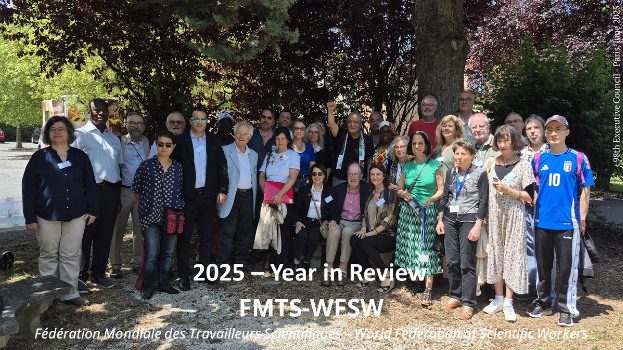
99th Executive Council of the World Federation of Scientific Workers
9–11 February 2026 (online)
Working Group 1: “Peace, Development and Cooperation”
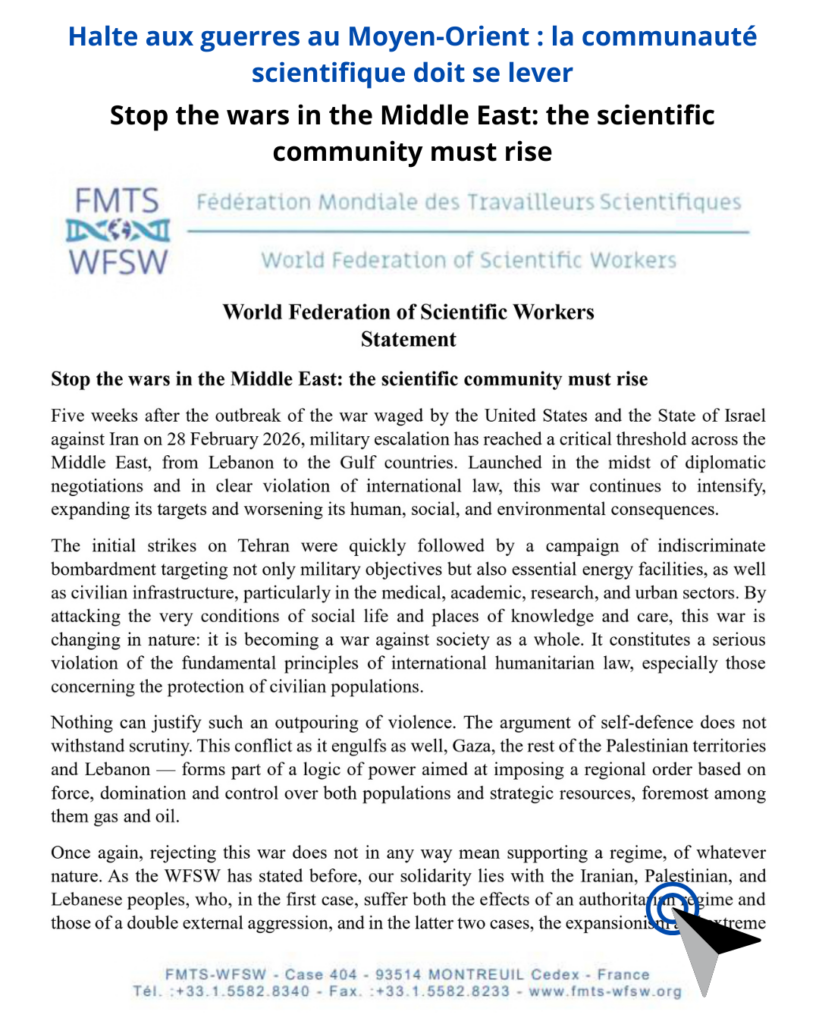
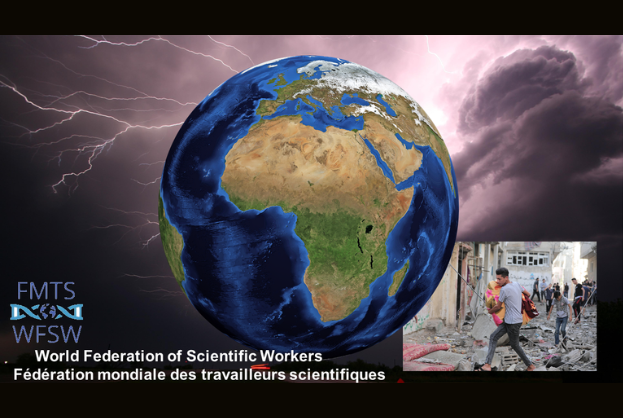
In the Middle East, the ongoing geopolitical reconfigurations — including the genocide unfolding in Gaza since October 2023 and Israeli expansionism throughout the region — are no accident. They follow a clear logic: the subjugation of the countries and peoples of the Arabian Peninsula to the converging interests, particularly energy-related, of the US imperial power and its regional allies, foremost among them the far right in Israel.
Certain petro-monarchies, partly theocratic, the Kingdom of Saudi Arabia in particular, whose leaders did not hesitate to assassinate an opponent (Jamal Khashoggi) in their consulate in Istanbul in 2018, are now key actors in this process. While two of them have already signed the Abraham Accords with the Israeli government – which is fully instrumentalising these regimes as auxiliaries, with diplomatic, financial, and military backing from Washington – they have aligned themselves closely with the aggressive approach of the Trump administration. In doing so, they have placed themselves in open opposition to the Palestinian people’s struggle for land, dignity, and rights, going so far as to enter into pacts with an Israeli far right that is openly hostile to any progressive or democratic prospect in the Middle East.
A comparable stance is taken towards Iran. Its leaders, themselves steeped in an exacerbated religiosity, must indeed be condemned for the unjustified violence inflicted on their citizens, particularly women. However, this can in no way justify their overthrow through foreign military interventions, notably by the United States and Israel. Imposing “democracy” and regime change by force has led to political and security disasters from which the region — and the world — still suffers, as seen since the turn of the century in Iraq, Afghanistan and Libya. And, as in Venezuela in early January 2026, in Korea in the 1950s, Vietnam in the 1970s, Chile in 1973, or Afghanistan between 2001 and 2021 — to mention only a few examples — US interventionism has produced nothing but devastation, death and ruin.
In Africa, a continent often stigmatised by the White House, the US expansionist strategy is also pursued with brutality. In South Africa, the break with the apartheid order is being fiercely challenged by Donald Trump and his powerful digital ally, Elon Musk. Thirty years after 1994, land and resource concentration remains in the hands of a minority descended from the European-origin population, in defiance of the aspirations of indigenous communities. At the same time, the South African government’s international initiatives are systematically obstructed whenever they seek to uphold international law and the rights of the Palestinian people, notably through referrals to the International Criminal Court. From this perspective, the country has become a major target of political and commercial attacks by both the United States and its Israeli ally.
Nigeria, a West African country, also appears to be caught in the vice. Under the convenient pretext of combating terrorism — particularly that perpetrated by Boko Haram — and protecting Christian populations, this country of over 230 million inhabitants is increasingly subjected to a security-driven tutelage. Such a strategy strengthens neither stability nor peace: it undermines national sovereignty and exacerbates internal divisions.
Sudan offers the most tragic example of this policy of chaos. A convergence of US–Israeli interests, supported by regional powers such as Egypt and the United Arab Emirates, is contributing to the country’s fragmentation. For more than two years, mass massacres have been taking place amid a deafening international silence, relegated to the background by the wars in Ukraine and the Middle East.
Not far from Sudan, in the Horn of Africa, Israel’s recognition of Somaliland forms part of a broader strategy aimed at permanently detaching this territory from historic Somalia, in order to anchor it within the US–Israeli sphere of influence.
What is taking shape, in effect, is nothing less than a new project of global domination. The fragmentation of states, the militarisation of territories and the instrumentalization of identity-based conflicts: the recipes of neo-colonialism are being recycled in renewed forms. From Southern Africa to East Africa, from Sudan to the Horn of Africa, and onwards to West Africa — notably Nigeria — a network is being woven to establish a lasting political and military presence. The objective is fully explicit: to marginalise the former European colonial powers, foremost among them France, and to impose the United States of America as the hegemonic power on the African continent — officially to counter China’s presence, but also that of Turkey and Russia.
In the face of this offensive, one thing is clear: it is the peoples who pay the highest price. Their right to self-determination, justice and dignity is sacrificed on the altar of imperial alliances. Silence is no longer an option. Solidarity among struggles – from the Palestinian people to African and Latin American peoples – remains one of the few bulwarks against this imperial enterprise of domination, initiated by US President Donald Trump from his first election in 2016 and revived with growing arrogance and rage since his return to the White House in January 2025.
February 5, 2026
________________________________________
PDF Document (English – French): WFSW99EC-WG1-Paper 1-ML_FC_2026-Fr-En
Graphic composition: OTC, Portugal
Portuguese version: https://otc.pt/wp/2026/09/02/geopolitica-da-submissao-africa-medio-oriente/