Rules of Procedure
RULES OF PROCEDURE FOR THE WFSW. The Internal Regulation.
Version 22/05/2025: To be finally voted on at the 24th General Assembly.
Only the English document is authentic.
PDF Document: 20250524 Rules of Procedures WFSW
Table of Contents
Preamble
A. How to become an Affiliated Organization
B. Individual Membership
C. Infringements, Sanctions and Litigation
D. Rules of the General Assembly
E. Rules of the Executive Council
F. Remote Participation Rules for the Executive Council
G. Rules of the International Secretariat
H. Rules for the President, the Vice-Presidents, the Secretary General and the Treasurer
H1. President
H2. Secretary General
H3. Treasurer
I. Bureau
J. Organization of individual members
K. Working groups and Sectors
L. Finance
M. Membership fees
N. Communication Procedures
O. Appendices
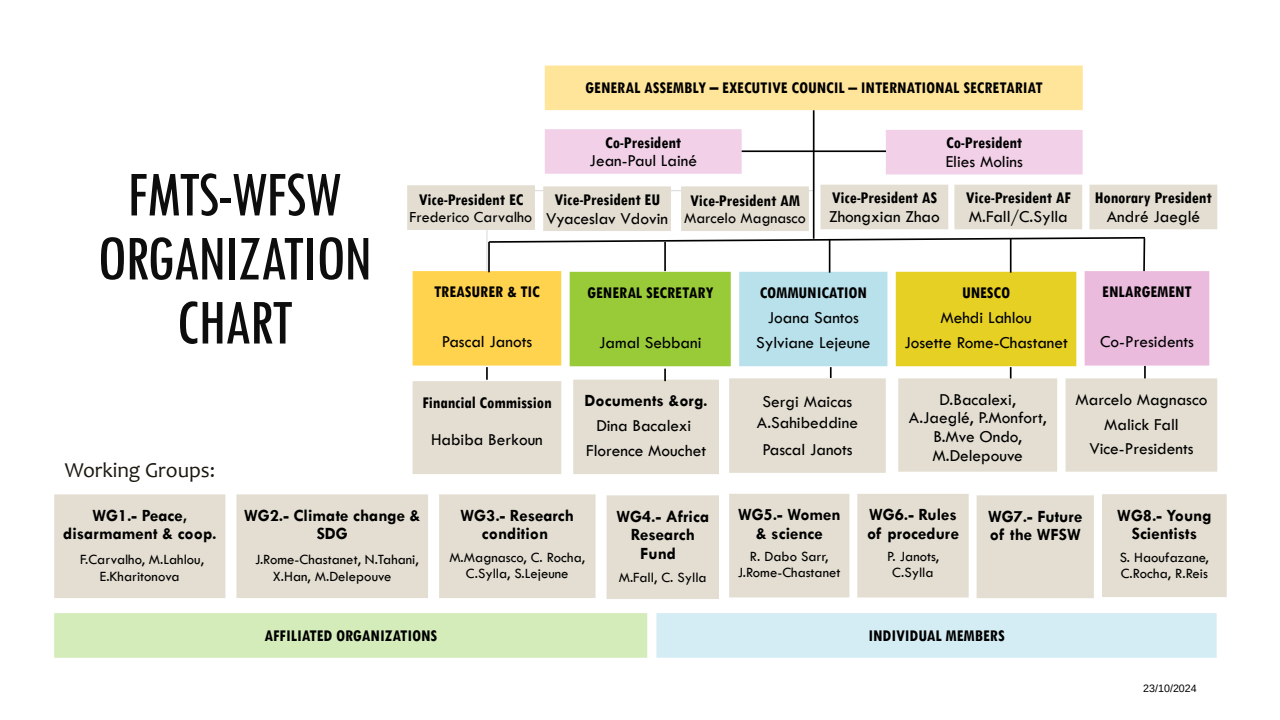
0.1 Organizational chart
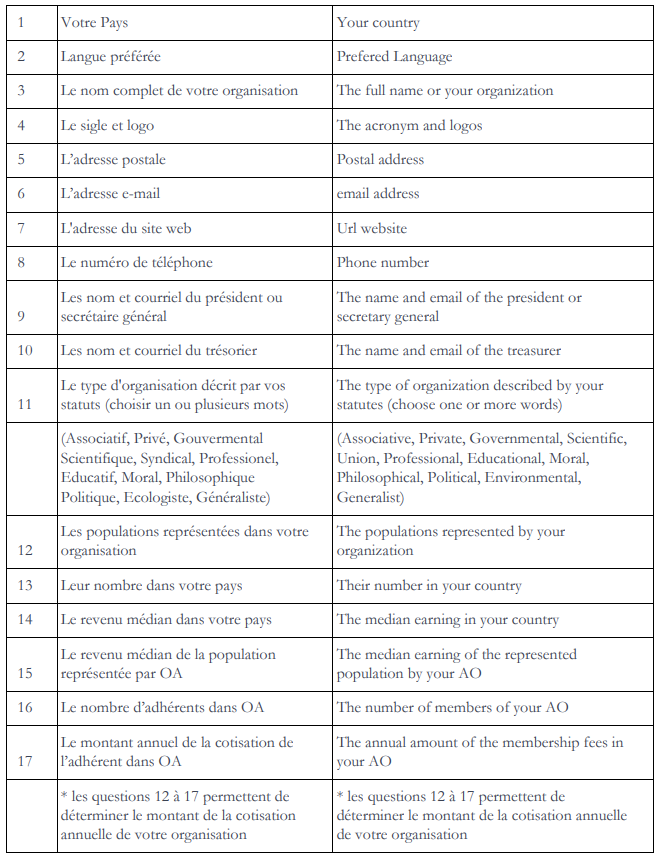
0.2 Applicant Organization Membership Form
Preamble
The Constitution, also named Statutes, of the World Federation of Scientific Workers, in its last version of 2013 (Nizhny Novgorod), refers to an internal regulation named Rules of Procedure. Although some partial regulations have been issued in the past, the mandate of the last General Assembly (Marrakech, 2022), confirmed by the 93th Executive Council (Paris, 2022), is that a Working Group (6th) should prepare a proposal of Rules of Procedure of the WFSW to be discussed in the 94th Executive Council (Évora, 2023).
For its preparation, it was taken into account the Constitution/Statutes, some previous partial regulations, as well as some usual procedures in the Federation that have demonstrated along the years its usefulness and convenience. Another relevant document is «The evolution of instances of the WFSW», already presented by the Working Group 6 to the 93th Executive Council.
A first incomplete version was adopted at the 94th Executive Council (Évora, 2023). It has also been decided that the specific rules for the General Assembly will be prepared later, probably for the 95th Executive Council at the end of 2023, provided that the next General Assembly is planned for 2026. This new version will be discussed and eventually approved in the 98thEC meeting.
A. The procedure for organizations wishing to join the WFSW is as follows:
1. A scientific workers’ organization wishing to join the WFSW must send a formal application to the General Secretariat, stating that it subscribes to the aims of the Federation and accepts its Constitution. It must complete the attached membership form (see N2). The application must include a presentation of the applicant organization and its founding texts. A meeting should be set up between the Federation Bureau and the representatives of the candidate organization to specify the procedures of their incorporation.
2. The application is examined at the next meeting of the Executive Council, which decides on the membership, subject to the ratification by the General Assembly. The applicant organization would be admitted, pending ratification of its membership.
Observation: Article 9 of the Articles of Constitution should be amended accordingly.
B. Individual membership
1. Applications for individual memberships of the WFSW must be submitted by two members, either of the International Secretariat or the Executive Council and from different affiliated organizations, with a full description of the applicant’s identity and activities.
2. However, when the applicant for individual membership comes from an affiliated organization (AO) which is a member of the WFSW, the Federation must ensure that there are no incompatibility and/or conflictual situations between the applicant for individual membership and the representation of the affiliated organization.
3. The Executive Council is the one who accepts the proposed membership. Individual members may be associated with certain activities or participate in the Executive Council, or in the work of certain working groups or sectors run by the Federation.
4. The General Assembly, is the one who ratifies the decisions of the Executive Council.
C. Offenses, penalties and disputes
1. In the event of serious breaches by members of either Federation’s constitution or internal regulations, members may be temporarily suspended or even expelled, whether they are affiliated organizations or individual members.
2. The decision to suspend is taken by the Executive Council, following a report presented by an ad hoc commission charged with investigating disputes or litigation. It must be ratified by the General Assembly.
3. A decision to exclude a member may only be taken by the General Assembly, on the basis of a report presented by the Executive Council.
D. Rules of the General Assembly of the WFSW
1. Purpose: The General Assembly of the WFSW serves as the highest decision-making body and is responsible for the overall governance and direction of the organization.
2. Membership: The General Assembly (GA) consists of all the delegates of the affiliated organizations and of one delegate from individual members, who are in good standing. Each member is entitled to attend and participate in the General Assembly meetings.
3. Notice of Meetings: The International Secretariat must provide written notice on the date and place to all members of the General Assembly meetings at least three months in advance. A further notice, at least two months in advance, should include the date, time, venue, and agenda of the meeting, as well as the necessary information for both remote participation and voting (according to the rule GA Art.14).
4. Chairs: The GA will be to be managed by a Board, elected by the GA, in which former President, General secretary and Treasurer are ex-officio members. The President chairs the first GA session and the former General Secretary prepare its report. Chairs and reporters of the other sessions are proposed by the Board and elected by the GA. This Board may propose to the GA the creation of Resolution Commissions ad hoc to analyze and prepare documents to be voted and, eventually, adopted.
5. A Credential Commission (CC) is elected, to apply article 10 of the Constitution. The outgoing treasurer is a member of the CC. The role of the CC is to verify the validity of delegates’ votes and to monitor the voting process. The credentials of delegates whose organization has not paid its dues since the previous GA up to and including the previous year are not validated. The CC presents a report to the GA containing a list of accredited delegates. Only accredited delegates may vote.
6. Nominating Commission (NC). The NC should be elected to prepare the list of nominations of bodies and officers proposed to be elected by the GA (see article 11 below).
7. Agenda: The International Secretariat should prepare and distribute an agenda prior to the General Assembly meeting, once the Executive Council has been consulted. The agenda should outline the topics to be discussed, and any member can propose additional items for inclusion before the meeting, provided the support of at least two other members of at least two AOs. Documents proposed for discussion and nominations of candidature proposal for members of the bodies and officers must be received by International Secretary thirty-five days before the opening of the General Assembly. The agenda may include reports, discussions, elections, and decision-making items. The Agenda is voted by the GA and managed by the Board.
8. GA opening: During the first session, the GA elects the Board, the Credential Commission, the Nominating Commission, and vote the agenda proposed by the former General Secretary.
9. Reports: The General Assembly may include reports from the former president, treasurer, committees and commissions, sectors, working groups or other relevant officers. These reports provide updates on the Federation’s activities, financial status, and any other pertinent information.
10. Discussions and Voting: The General Assembly allows for open discussions on the agenda items. Members can express their opinions, ask questions, and seek clarifications. Once discussions are concluded, a voting may be proposed on specific matters requiring a decision. The concrete question to be voted, including elections, with the different options allowed, must be informed the day before the voting process. The voting process may include show of hands, secret ballot, or other appropriate methods.
11. Election of bodies and officers: According to the Constitution, The GA must elect the members of bodies, Executive Council, International Secretariat, Financial Committee and the officers, the President, Vice Presidents, General Secretary, and Treasurer. Every candidate to the bodies shall be nominated by members of the Federation and, for the officers, nominated at least by three members. The lists presented to vote must be prepared, from the nominated candidates, by the Nominating Commission. The candidature proposals must be sent to the international Secretariat thirty days before beginning of the General Assembly.
12. Decision-Making: Decisions at the General Assembly are generally made by a majority vote, unless otherwise specified in the bylaws. Some critical decisions, such as amendments to the Federation’s constitution or dissolution, requires a special majority of two thirds of the delegates present. Members of the bodies and officers are elected by secret ballots.
13. Minutes: Accurate minutes should be kept for each General Assembly meeting. The minutes should include the date, time, location, attendees, decisions made, and any other relevant information. These minutes serve as an official record of the meeting and should be made available to all members.
14. Amendments to the Constitution: They may be proposed by any member of the Federation, three months before the GA. The Executive Council examine the proposal and report its recommendation and own proposals. The GA discuss and vote the amendments proposed, respecting the number of approvals, regarding the article 22 of the constitution.
15. Extraordinary General Assembly: In exceptional circumstances, an Extraordinary General Assembly may be called to address urgent matters that cannot wait until the regular General Assembly meeting. An Extraordinary General Assembly may be called by the President with the support of at least one third of the members of the Executive Council.
Particular Rules for Remote Participation and Voting
16. Purpose: The purpose of these rules is to establish guidelines and procedures for remote participation and voting in the General Assembly meetings of the Federation. These rules aim to ensure transparency, inclusivity, and effective decision-making while accommodating members who are unable to attend in person.
17. Definitions: a) General Assembly: Refers to the official meeting of the Federation’s members. b) Remote Participation: The ability for members to attend and participate in the General Assembly meetings remotely, using technology such as video conferencing or teleconferencing. c) Remote Voting: The process by which members cast their votes on agenda items during the General Assembly meetings, even if they are not physically present.
18. Notification: a) The International Secretariat shall provide adequate advance notice of the General Assembly, including information regarding the option for remote participation and voting (according to the rule GA Art.3). b) The notification should specify the technology platform or method to be used for remote participation and voting, along with any instructions or prerequisites for accessing the meeting.
19. Eligibility for Remote Participation and Voting: a) All validated delegates of the Federation shall have the right to participate and vote remotely in the General Assembly unless otherwise specified in the Federation’s bylaws. b) Members must comply with any technical or procedural requirements specified for remote participation and voting.
20. Verification of Identity: a) Prior to the General Assembly, the International Secretariat shall establish a process to verify the identity of members participating remotely. b) The verification process may involve methods such as requesting members to provide identification documents or using secure authentication mechanisms.
21. Access to Meeting Materials: a) The International Secretariat shall ensure that all members, whether attending in person or remotely, have access to the relevant meeting materials, including the agenda, reports, and proposed resolutions. b) The materials should be provided in a timely manner, allowing members to review and prepare for the General Assembly. c) The cloud at the WFSW site seems a convenient way to store and gives access of these materials to all the delegates.
22. Conduct of Remote Participation: a) Members participating remotely shall adhere to the same rules of conduct as those attending in person. b) Participants shall use the designated technology platform for audio and/or video communication during the General Assembly. c) The International Secretariat may establish additional guidelines to ensure orderly and respectful participation, such as raising hands or using chat features to indicate a desire to speak.
23. Voting Procedures: a) Members participating remotely shall have equal voting rights as those attending in person. b) The International Secretariat shall establish a secure and auditable system for remote voting. c) Prior to voting, the chairperson or designated facilitator shall clearly announce the voting item, provide any necessary context, and specify the voting method (e.g., voice vote, show of hands). d) The Federation may use electronic voting systems or other suitable methods to facilitate remote voting. e) Votes shall be recorded and included in the official meeting minutes.
24. Decisions: a) Decisions shall be made based on the voting results, including both in-person and remote votes, as applicable. b) The Federation shall maintain accurate records of the voting outcomes and ensure they are reflected in the meeting minutes.
25. Technical Difficulties: a) In the event of technical difficulties that impede remote participation or voting, the Federation may adjourn the meeting temporarily to resolve the issues. b) Reasonable efforts shall be made to assist members in troubleshooting technical problems if feasible.
26. Confidentiality and Security: a) All remote participants shall adhere to the confidentiality and security measures outlined by the Federation. b) The Federation shall implement appropriate measures to protect the integrity and confidentiality of remote meetings and voting processes.
27. Equal Opportunities and Accessibility: a) The Federation shall make efforts to ensure that remote participants have equal opportunities to express their views, participate in discussions, and ask questions during the General Assembly. b) Reasonable accommodations should be provided to facilitate the participation of members with disabilities or other accessibility needs.
28. Recording and Minutes: a) The Federation may record the General Assembly meetings, including both in-person and remote participation, for record-keeping purposes. b) The minutes of the General Assembly shall accurately reflect the discussions, decisions, and voting outcomes, including both in-person and remote votes.
29. Compliance with Bylaws and Applicable Laws: a) The Federation’s bylaws shall apply to all aspects of remote participation and voting, unless specified otherwise in these rules. b) The Federation shall comply with applicable laws, regulations, and guidelines governing remote meetings and voting.
30. Amendments to the Rules: a) These rules for remote participation and voting in the General Assembly may be amended by a majority vote of the members present, both in-person and remotely, in a properly convened General Assembly meeting.
E. Rules of the Executive Council of the WFSW
1. Purpose: The Executive Council of the WFSW serves as the governing body responsible for managing operations, making decisions, and implementing the policies and objectives of the Federation, in particular those decided in the General Assembly.
2. Composition: The Executive Council is elected by the General Assembly and it is usually comprised of forty members among the delegates of the Affiliated Organizations, Individual Members and the International Secretariat. All the Affiliated Organizations have the right to have at least one representative in the Executive Council.
3. Meetings: The Executive Council should hold regular meetings to discuss and address Federation matters. The frequency of these meetings currently is twice a year, one face-to-face and one remote. Although remote participation in the face-to face meeting should be offered. The meeting development is organized in sessions. The opening session establishes the agenda and includes the Presidents and Treasurers reports. The closing session usually summarizes the decisions taken, that should be implemented by the International Secretariat, and the proposed date and place of the next meeting.
4. Notice of Meetings: Proper notice of meetings on the date and place should be provided to all members of the Executive Council at least three months in advance. A further notice, at least one month in advance, should include the date, time, venue, and agenda of the meeting, as well as the necessary information for both remote participation and voting.
5. President: The President, the Vice-president of the Executive Council or a designated individual chairs the Executive Council meetings. The President is responsible ensuring a good development of the meeting and adherence to the agenda, facilitating discussions, and promoting effective decision-making. The General Secretary or a designated Vice-President prepares the report of the Executive Council meeting. There may be nominated rapporteurs for each session.
6. Agenda: The International Secretariat should prepare and distribute an agenda prior to each Executive Council meeting. The agenda should outline the topics to be discussed and any relevant documents or reports that members should review in advance. Council members may propose additional items for inclusion on the agenda before the meeting. The agenda may include reports, discussions, elections, and decision-making items.
7. Reports: The Executive Council meeting may include reports from the President, Treasurer, committees and commissions, sectors and working group leaders and other relevant officers. These reports provide updates on the progress of ongoing projects, financial matters, membership status, and any other pertinent information. Council members may have the opportunity to ask questions or seek clarifications on the reports.
8. Discussions and Decision-Making: The Executive Council meetings allow for open discussions on the agenda items. Council members can express their opinions, provide input, and engage in constructive dialogue. Once discussions are concluded, decisions can be made through a formal voting process. The concrete question to be voted, including elections, with the different options allowed, must be informed the day before the voting process. The voting process may include show of hands, secret ballot, or other appropriate methods.
9. Minutes: Accurate minutes should be kept for each Executive Council meeting. The minutes should include the date, time, location, attendees (present or remote), decisions made, and any other relevant information. These minutes serve as an official record of the meeting and should be made available to all council and Federation members.
10. Emergency Decision-Making: In urgent situations that require immediate action, the Executive Council may make decisions through the emergency procedure outlined in the Federation’s statutes, by using electronic vote. The procedure should ensure its accountability and transparency.
F. Remote participation rules for the Executive Council
1. Remote participation: The purpose of these following rules is to establish guidelines and procedures for remote participation and voting in the Executive Council meetings of the Federation. These rules aim to ensure transparency, inclusivity, and effective decision-making, while accommodating members who are unable to attend in person.
2. Definitions: a) Executive Council: Refers to the official meeting of the Federation’s members. b) Remote Participation: The ability for members to attend and participate in the Executive Council meetings remotely, using technology such as video conferencing or teleconferencing. c) Remote Voting: The process by which members cast their votes on agenda items during the Executive Council meetings, even if they are not physically present.
3. Notification: a) The International Secretariat shall provide adequate advance notice of the Executive Council, including information regarding the option for remote participation and voting. b) The notification should specify the technology platform or method to be used for remote participation and voting, along with any instructions or prerequisites for accessing the meeting.
4. Eligibility for Remote Participation and Voting: a) All Council’s members shall have the right to participate and vote remotely in the Executive Council, unless otherwise specified in the Federation’s statutes. b) Members must comply with any technical or procedural requirements specified for remote participation and voting.
5. Verification of Identity: a) Prior to the Executive Council, the Federation shall establish a process to verify the identity of members participating remotely. b) The verification process may involve methods such as requesting members to provide identification documents or using secure authentication mechanisms.
6. Access to Meeting Materials: a) The association shall ensure that all members, whether attending in person or remotely, have access to the relevant meeting materials, including the agenda, reports, and proposed resolutions. b) The materials should be provided in a timely manner, allowing members to review and prepare for the Executive Council.
7. Conduct of Remote Participation: a) Members participating remotely shall adhere to the same rules of conduct as those attending in person. b) Participants shall use the designated technology platform for audio and/or video communication during the Executive Council. c)The Federation may establish additional guidelines to ensure orderly and respectful participation, such as raising hands or using chat features to indicate a desire to speak.
8. Voting Procedures: a) Members participating remotely shall have equal voting rights as those attending in person. b) The Federation shall establish a secure and auditable system for remote voting. c) Prior to voting, the President or designated facilitator shall clearly announce the voting item, provide any necessary context, and specify the voting method (e.g., voice vote, show of hands). d) The Federation may use electronic voting systems or other suitable methods to facilitate remote voting. e) Votes shall be recorded and included in the official meeting minutes.
9. Decisions: Decisions shall be made based on the voting results, including both in person and remote votes, as applicable. The association shall maintain accurate records of the voting outcomes and ensure they are reflected in the meeting minutes.
10. Technical Difficulties: a) In the event of technical difficulties that impede remote participation or voting, the association may adjourn the meeting temporarily to resolve the issues. b) Reasonable efforts shall be made to assist members in trouble shooting technical problems, if feasible.
11. Confidentiality and Security: a) All remote participants shall adhere to the confidentiality and security measures outlined by the Federation. b) The Federation shall implement appropriate measures to protect the integrity and confidentiality of remote meetings and voting processes.
12. Equal Opportunities and Accessibility: a) The association shall make efforts to ensure that remote participants have equal opportunities to express their views, participate in discussions, and ask questions during the Executive Council. b) Reasonable accommodations should be provided to facilitate the participation of members with disabilities or other accessibility needs.
13. Recording and Minutes:
a) The Federation may record the Executive Council meetings, including both in-person and remote participation, for record-keeping purposes.
b) The minutes of the Executive Council shall accurately reflect the discussions, decisions, and voting outcomes, including both in-person and remote votes.
14. Modifications of the Rules:
These rules for remote participation and voting in the Executive Council may be amended by a majority vote of the members present, both in person and remotely, in a properly convened Executive Council meeting.
G. Rules of the International Secretariat
1. Purpose: The World Federation of Scientific Workers is managed by the International Secretariat, elected by the General Assembly. It supports the Federation in achieving its global objectives and facilitates communication and collaboration among member entities. It is responsible for the permanent administration of the Federation. In particular, it prepares the meetings of the statutory bodies (Executive Council, General Assembly) and organizes the implementation of their decisions.
2. Composition: The International Secretariat is composed of at least seven members and a maximum of twenty, with official functions: The President, two Vice-Presidents representing different regions, the Vice-President of the Executive Council, the General Secretary, the Treasurer and, if exist, the Deputy General Secretary and Deputy Treasurer. Any unavoidable change in its composition must be approved by the Executive Council.
3. Meetings: The International Secretariat hold regular meetings to discuss and address Federation matters. The frequency of these meetings currently is once a month, typically its first Monday at 2 p.m. (Paris time), to allow a compromised schedule among the different time zones.
4. Functions and Responsibilities: The International Secretariat’s functions and responsibilities may include, but are not limited to:
a. Managing the day-to-day operations of the WFSW.
b. Facilitating effective communication and coordination among member entities.
c. Organizing and coordinating international meetings, conferences, and events.
d. Serving as a central point of contact for member entities and external partners.
e. Collecting, analyzing, and disseminating information relevant to the Federation’s activities.
f. Supporting the development and implementation of international projects, initiatives, or campaigns.
g. Maintaining relationships and partnerships with international organizations, governments, and other relevant entities.
h. Managing the Federation’s budget, financial transactions, and reporting.
i. Providing administrative support to the Federation’s commissions, sectors or working groups.
j. Representing the Federation in international forums, conferences, and negotiations.
k. Deciding the diffusion of the proposed information and documents by consensus or by a majority of the members present.
5. Coordination with Affiliated Organizations: The International Secretariat should work closely with the affiliated organizations of the Federation to ensure common objectives, exchange of information, and collaboration, mainly on international matters. Regular communication and coordination mechanisms should be established to facilitate this relationship. For instance, e-mail and distribution lists, instant message applications, cloud folders, common calendar, and other team working tools.
6. Reporting: The International Secretariat provide regular reports to the Federation’s governing bodies, such as the General Assembly or Executive Council, on the activities, achievements, and challenges found. These reports should include financial updates, progress on projects, and other relevant information.
7. Emergency Decision-Making: In urgent situations that require immediate action, the International Secretariat may make decisions through the emergency procedure outlined in the Federation’s statutes. The procedure should ensure its accountability and transparency.
8. Staffing: The International Secretariat may have a dedicated staff responsible for carrying out its functions. The staffing structure, roles, and responsibilities should be defined and documented. The recruitment, selection, and management of staff members should follow established procedures and guidelines.
9. On-line administration: The on-line administration of the Federation’s contacts, meetings and publications requires the creation, management and maintenance of complex IT systems (servers, e-mail addresses, mailing lists, websites, clouds, video-communication) which must be placed under the supervision of the International Secretariat, which assigns responsibility for one or more tools to certain of its members.
H. Rules for the President, Vice-Presidents, General Secretary, and Treasurer of the WFSW:
H1. President:
1. Leadership: The president is the legal representative of the WFSW. As highest-ranking officer of the Federation, serves as a spokesman and provides leadership and direction to the organization.
2. Duties and Responsibilities: The president’s responsibilities may include, but are not limited to:
a. Presiding over meetings of the General Assembly, Executive Council, International Secretariat and Bureau.
b. Representing the Federation in external matters, such as meetings, events, and public engagements.
c. Overseeing the implementation of the Federation’s goals, policies, and objectives, in particular, the decisions taken by the General Assembly, the Executive Council and the International Secretariat.
d. Facilitating effective communication among members, commissions, and officers.
e. Implementing strategic decisions in consultation with the Executive Council and the International Secretariat.
f. Appointing individuals to commissions or special positions as necessary.
g. Serving as a spokesperson for the Federation and advocating for its interests.
3. Term of Office: The president’s term of office is the General Assembly.
H2. Vice-presidents:
1. Representation: The Vice-presidents are also representatives of the WFSW.
2. As a global organization, the Vice-presidents have been traditionally associated to continents or large regions. The Vice-President of the Executive Council is a member of the International Secretariat and may chair the executive Council.
3. Duties and Responsibilities: The Vice-presidents’ responsibilities may include, but are not limited to:
a. Representing the Federation in external matters, such as meetings, events, and public engagements, especially those celebrated in their associated region.
b. Assuming tasks specifically delegated by the president.
4. Term of Office: The Vice-presidents’ term of office is the General Assembly.
H3. General Secretary:
1. Administration: The general secretary is responsible for managing the administrative functions of the Federation.
2. Duties and Responsibilities: The general secretary’s responsibilities may include, but are not limited to:
a. Ensuring the accurate record-keeping of the Federation’s documents, including minutes of meetings, membership records, and correspondence.
b. Handling official correspondence and communications, both internal and external.
c. Preparing and distributing notices, agendas, and other relevant materials for General Assembly and Executive Council meetings.
d. Ensuring an adequate relationship with the UNESCO, in collaboration with the specific sector.
e. Assisting the president in coordinating the activities of the Federation.
f. Keeping members informed about Federation’s activities, events, and deadlines, in collaboration with the communication sector.
g. Managing membership applications, renewals, and records; in particular, keeping up-to-date lists of members and contacts, including their contact details.
h. Providing support to sectors, working groups and commissions, as needed.
3. Term of Office: The general secretary’s term of office is the General Assembly.
H4. Treasurer:
1. Financial Management: The treasurer is responsible for managing the Federation’s finances and ensuring financial transparency.
2. Duties and Responsibilities: The treasurer’s responsibilities may include, but are not limited to:
a. Monitoring the Federation’s financial transactions and expenses, including the collection of membership fees, donations, and other revenues.
b. Maintaining accurate and up-to-date financial records, including income, expenses, and bank statements.
c. Preparing and presenting financial reports to the General Assembly and Executive Council.
d. Developing and managing the Federation’s budget according to the Executive Council guidelines.
e. Participating in grant applications.
f. Ensuring compliance with financial regulations, tax requirements, and reporting obligations.
g. Coordinating with the financial commission for annual audits or reviews.
h. Providing financial guidance and support to the Federation’s committees or projects.
i. Managing the bank accounts and facilitating the reimbursement of expenses incurred by members or officers, in accordance with the Federation’s policies.
3. Term of Office: The treasurer’s term of office is the General Assembly.
I. Bureau:
1. Purpose: Operating an IS with up to 20 members obviously means preparing meetings and agendas, ensuring consistency between the actions of those in charge of working groups and sectors, and monitoring the implementation of decisions. This internal structure of the IS, known as the «Bureau», is not a statutory body (this sentence will disappear when the new constitution would be approved). Its management function is only effective through validation by the IS and the EC.
2. Composition: The Bureau comprises the President, the General Secretary and the Treasurer. The President may invite other International Secretariat members to attend the Bureau meetings.
3. Meetings, Functions and Responsibilities: The Bureau responsibilities may include, but are not limited to:
a. Preparing for bodies meetings; in particular, their agenda.
b. Organizing the implementation of resolutions. Currently, the bureau meets once before and once after each International Secretariat to deal with both main objectives.
J. Organization of individual members
1. A mailing list of individual members is set up with the Bureau to enable them to exchange ideas and proposals. Individual members are regularly informed by the Bureau of the Federation’s activities.
2. The Bureau organizes an annual meeting of individual members, at which the Federation’s activities are discussed and an individual member representative is elected.
3. The individual member representative attends meetings of the Executive Council and the General Assembly.
K. Working groups and Sectors
1. Thematic tasks are distributed in the working groups and sectors. Two sectors have been created:
a. UNESCO. WFSW, as an official partner of UNESCO, should have frequent contact with it, i.e., participating in its activities and meetings, proposing initiatives, etc.
b. Communication, which includes Organization and Logistics (see Organigram). It deals both with internal and external communication, ensuring a fluent flux of information inside the Federation and promoting the visibility of the WFSW and its activities towards the society.
Eight working groups are currently devoted to:
1. Peace, disarmament and cooperation.
2. Climate change and Sustainable Development Goals.
3. Research condition.
4. Africa research fund.
5. Women and science.
6. Rules of procedure.
7. The future of the Federation.
8. Young scientists.
2. Any member of the governing bodies can adhere to any working group. Working group leaders are appointed by the International Secretariat, on the recommendation of its members. Leaders are required to hold regular meetings of their sector or working group, and to report regularly on its activities to the International Secretariat. Other members of the Federation, like individuals or members of the affiliated organizations can also be members of the working groups. The International Secretariat has also the right to co-opt for the sectors and working groups.
L. Finance
1. Each year, the budget for the following year is voted on at the last meeting of the Executive Council, after examination of the provisional accounts. The budget comprises an “ordinary expenditure” section based on the results of previous years, plus a “specific operations” section forecast for the coming year. Income and expenditure are balanced. The treasurer commits expenses in accordance with the budget.
2. Income is composed by the member fees and grants or donations obtained that, in no case, may jeopardize the aims and spirit of the Federation.
M. Membership Fees
1. The amount of the budget determines a possible percentage increase which is reflected in the fees of affiliated organizations and members.
2. The membership fee of the affiliated organization is determined by a Coefficient of the affiliated organization multiplied by the membership fee of the affiliated organization multiplied by the number of members of the affiliated organization.
3. Calculating the affiliated organization’s coefficient is determined by a discussion between the Federation management (President, Treasurer, General Secretary) and the management of the affiliated organization AO. The indications used to determine it are the relative purchasing power of the country, the relative purchasing power of the AO members, the individual membership fee of the organizations, the number of members and the type of AO organization (bringing together a category organizations).
4. The coefficient can be multiplied each year by the percentage increase of the budget.
5. This coefficient is updated each year following the General Assembly guidelines.
6. Individuals membership fees are updated for the year following the General Assembly guidelines.
N. Communication Procedure
0. Introduction
The responsibility of some scientific workers promoted the creation of the WFSW with the aim that science would be a tool for peace and for common benefit. In this sense, the visibility of the WFSW is a necessary key aspect to reach this objective and to progress towards becoming more influential. With new communication media, the WFSW has the opportunity of a widespread distribution of information at low cost. The intention of this procedure is to establish an easy method with distributed tasks since a proposal for diffusion to its publication in our website, social media and distribution lists.
1. The Communication sector will periodically meet with the aim of analyzing and improving the visibility of the WFSW.
2. A Communication cloud page will centralize documentation. Its current link is: https://nuage.fmts-wfsw.org/index.php/s/Eq74pBWjbZzzjEJ.
3. Proposed information should be exposed and detailed in a document that has to be uploaded in the folder « Posts Proposal ». Also, it must be registered in the « Posts Proposed »spreadsheet.
4. The Communication sector should periodically verify the spreadsheet and see if the content of the document is complete and, if necessary, to contact the originator for clarification.
5. The International Secretariat will eventually approve, or not, the diffusion of the new information proposed. Relevant activities of the affiliated organizations do not need this approval.
6. Once approved, the corresponding responsible of the Communication sector will publish it either in the website, social media or distribution lists. Of course, that depending on the case, it can be diffused in some or all of them.
7. There are four major lists of contacts: i) members of the Executive Council and the Financial Commission, ii) members of the Federation (affiliated organizations and individuals), iii) members of friend organizations of the Federation, and iv) institutional contacts of the Federation. So, an information can be either sent to any of the four distribution lists (i.e., i, i+ii, i+ii+iii, etc.).
8. An optimal goal would be to issue one new each week.
O. APENDICES
O1. ORGANIZATION CHART
O2. Membership questionnaire for candidate organizations – Questionnaire d’adhésion des organisations candidates