Hybrid Warfare
HYBRID WARFARE
Frederico Carvalho* and Mehdi Lahlou**
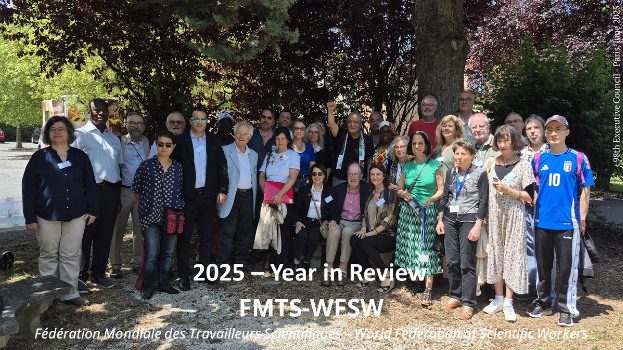
98th Executive Council Meeting of the World Federation of Scientific Workers
Paris, France, June 9–13, 2025
A Contribution to the debate within
Working Group 1: “Peace, Development and Cooperation”
The face of war has changed. Scientific and technological advances, which have accelerated over the past half-century, have led to the development of several so-called disruptive technologies, currently exploited by dominant global powers and their armed forces. This once again confirms the ambivalent nature of scientific progress. The problem lies not so much in science itself as in the organisation of society, which can either distort it or use it to meet the fundamental needs of all its components. It is therefore important for scientific workers, particularly those who identify as peace activists, to be aware of these facts so that they may — and indeed do — pass on to their fellow citizens the conviction that scientific knowledge must be preserved as a common good of humanity, while also denouncing and outlawing its improper, dangerous and deadly applications. It will be especially important to develop educational initiatives that not only awaken the curiosity of younger generations towards scientific and technological progress, but also raise their awareness of the negative social impacts of its misuse or hazardous application.
Science applied to warfare increasingly consumes human, material, and financial resources. And it is transforming the face of war. We are now speaking of disruptive technologies and hybrid warfare.
The concept of hybrid warfare is now used to describe a range of conflicts involving a combination of conventional military tactics and modern strategies such as cyberwarfare, information manipulation, economic disruption, psychological operations, and even terrorism or criminal activities within the operational space of the battlefield. This space goes far beyond what is traditionally considered a battlefield or theatre of operations, encompassing not only the populations in the conflict zone but also the international community as a whole. The enemy, so to speak, may include both state and non-state actors.
Disruptive technologies are widely used in hybrid warfare. High-powered lasers and highvoltage/energy electromagnetic radiation beams can be used to destroy satellites in Earth orbit and to jam communication networks of all kinds, whether civilian or military. Satellite network technologies are employed for intelligence gathering and have proved especially “advantageous” in military operations, offering real-time data transmission and surveillance capabilities.
There is talk of suicide satellites capable of carrying a small nuclear charge and detonating it near other satellites to destroy them. Advances in artificial intelligence have enabled the creation of robotic weapons capable of carrying out destructive actions without human intervention: these are the so-called Lethal Autonomous Weapon Systems (LAWS).
Advanced applications of artificial intelligence (AI) are used to identify and designate targets for destruction by interpreting data from various sensors, often, but not exclusively, infrared, thermal, and radar. They enable and are used for, precise identification of human targets through facial recognition. The so-called Israeli “defence”
forces are making use of this technology in Gaza. Drones, widely used in Ukraine, for instance, are evolving, gaining new qualities and capabilities through AI, which even enables “swarming” — involving several drones operating together to achieve a common objective, often with minimal human intervention.
Significant progress in the field of gene editing allows for the creation of genetically modified infectious viruses, capable of directly altering the chromosomes of crops in the fields. Advances in cybernetics, crucial for the development of robotic systems, make it possible to interfere with the functioning of automatic control, regulation, and communication systems and mechanisms, and may, through cyberattacks, paralyse vital civil infrastructure such as power plants.
Economic sanctions and the blocking of regular supplies of food or medicine, for example, are also forms of hybrid warfare that we unfortunately witness today. Hunger is used as a weapon of war. This is currently taking place in Gaza. There are also historical examples of such inhumane practices. A notable case is the Nazi siege of Leningrad, which lasted 872 days and resulted in the death of a million people.
To this must be added a worrying trend toward the increasing privatisation of war technologies. More and more, private companies are developing, controlling, and selling surveillance tools, spyware, or intelligent weapons systems. This outsourcing of sovereign functions to commercial interests poses a major democratic problem, as it often escapes all citizen or parliamentary oversight. Trade secrecy replaces public debate, and
the logic of profit overtakes that of peace.
Moreover, the trivialisation of technological discourse and the fascination with constant innovation obscure the essential question of ethics. Very few institutional spaces today allow for meaningful debate on the aims of scientific research. And yet, for science to progress, it must do so with conscience. The responsibility of researchers, engineers, as well as political and economic decision-makers, is enormous. It is time to establish clear and universal safeguards on the military applications of new technologies, in the spirit of what was once attempted with chemical and nuclear weapons.
We believe the above considerations can serve as healthy “food for thought” — that is, they are worthy of serious reflection. At stake is not only the future of science, but the future of humanity itself.
Villejuif, 26 May 2025
____________________________________________
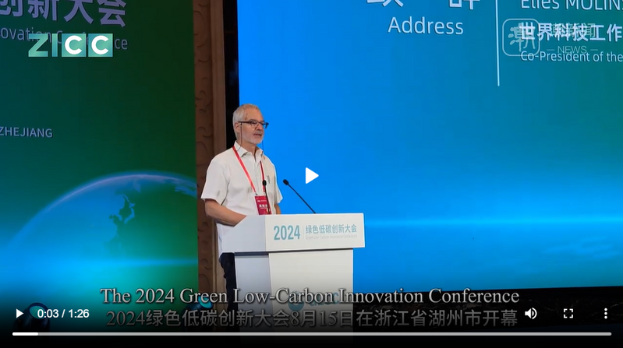
*Frederico Carvalho, PhD in Physics, Lisbon University and Dr.Ing.in Nuclear Engineering, Karlsruhe University. Germany, is Senior Researcher (retired) of the Dept. of Nuclear Science and Engineering, Instituto Superior Técnico, Lisbon University. He is President of the Board of Directors of OTC-Organização dos Trabalhadores Científicos, Portugal, Vice-President of the Executive Council of the World Federation of Scientific Workers and a member of World Federation’s International Secretariat.
**Mehdi Lahlou is Professor of Economics at the National Institute of Statistics and Applied Economics (INSEA), Rabat, Morocco, and Associate Professor, University Mohammed V (Rabat). He is a member of the Executive Council of the World Federation of Scientific Workers and a member of the World Federation’s International Secretariat.
____________________________________________
Graphic Composition: OTC, Portugal
Portuguese version: https://otc.pt/wp/2025/07/04/novas-faces-da-guerra/
__________________________________________