Strengthening Bonds for the Future
THE NEED TO WEAVE A BROAD COMMUNITY OF SHARED INTERESTS AND COMMON GOALS
Frederico Carvalho and Mehdi Lahlou
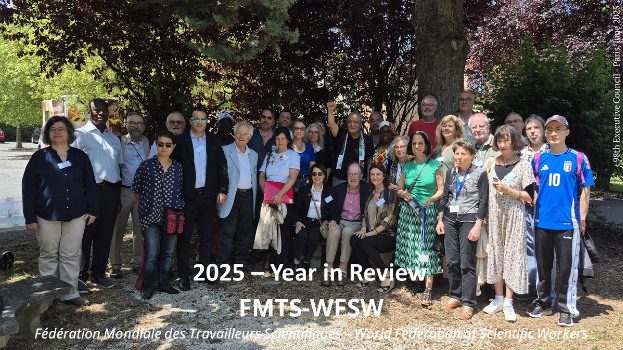
98th Executive Council Meeting of the World Federation of Scientific Workers
Paris, France, June 9–13, 2025
A Contribution to the debate within
Working Group 1: “Peace, Development and Cooperation”
“For the founders of the World Federation of Scientific Workers (WFSW), the most important of its initial objectives was to establish links between colleagues from different parts of the world, especially between those living and working in politically opposed nations or blocs, where tensions can at any moment escalate into widespread conflict. This ambition remains as relevant today as ever.”
Establishing such connections is of paramount importance in creating a united front, thereby increasing the chances for the scientific community to meaningfully influence the course of events—events that are shaped by the decisions of those who effectively hold the power to determine the future of our societies, and indeed the fate of humanity on this planet.
Scientific workers in different countries, under varying employment conditions and in diverse sectors—whether public or private—naturally have differing needs and experience various constraints in their professional and personal lives. They are likely to assess both the threats and promises of the future differently, at local as well as global levels. This only strengthens the genuine importance of building connections among us all, as we rightly emphasise in many of our publications.
It is also crucial to highlight the need for scientific workers to engage with their fellow citizens, drawing on their professional experience, specialised knowledge, and skills to contribute honestly to fostering, in those they engage with, an informed and unbiased interpretation of the paths towards which the world is being driven, and the obstacles that lie in those paths. The dialogue we must seek should aim to clarify the nature,
origins, and significance of the threats we face in the current geopolitical context.
The vast majority of organisations affiliated with our federation are trade unions, either professional or general worker unions. Their core objectives involve defending the rights, interests, and gains of their members as salaried workers. Only a relatively small proportion of their members actively engage in actions directly addressing key issues such as peace, disarmament, and cooperation. Given the crucial role of trade unions in society, it is essential to revive among their members an awareness of the need to struggle for peace, which again presupposes dialogue to clarify the nature and roots of the threats that affect us all.
Some of the member organisations are NGOs. Not only these, but NGOs in general, can play a significant role in a large-scale campaign for peace, disarmament, and cooperation. Some already do so, notably several NGOs that are members of ICAN – the International Campaign to Abolish Nuclear Weapons – as well as member
associations of the World Peace Council. NGOs encompass a wide array of areas of interest, often without direct ties to science or scientific research. Scientific workers committed to peace should take to heart the need to foster dialogue with various NGOs, which could benefit from their expertise to deepen awareness and
understanding of the current situation.
In light of growing international tensions, the proliferation of military arsenals— including nuclear weapons—and the spread of armed conflicts in numerous regions of the world, the time has come for a general mobilisation in favour of complete disarmament. Silence or neutrality in the face of escalating military expenditure and increasing recourse to force is no longer acceptable. The resources squandered on wars and/or their preparation must be redirected towards objectives that serve humanity: education, health, access to clean water for all, ecological transition, social justice, and more.
Scientific workers, as bearers of knowledge and critical consciousness, have a particular ethical responsibility: to oppose the instrumentalization of science in the service of power and destruction. Far too often, scientific and technological advances have been diverted to benefit military—and therefore deadly—industries. It is now
more than time to reverse this trend by clearly affirming that every scientific innovation must be judged not only by its performance but also by its impact on peace and human dignity—in other words, on the preservation of life on our shared Earth. For we have no other.
We must therefore advocate for a reordering of global economic, social, political, and ecological priorities. True security does not lie in nuclear deterrence or military superiority, but in international cooperation, respect for the rule of law, combating inequality, and building democratic and inclusive institutions within all societies across the world. Disarmament should not be seen as weakness, fragility, or a surrender of sovereignty, but as an act of courage, rationality, and wisdom—and ultimately as a historic responsibility towards humanity as a whole.
In this spirit, the creation of a broad community of shared interests and common goals, bringing together scientists, trade unionists, NGOs, and progressive political actors, is more urgent than ever. It is by uniting our forces in diversity, and by putting science at the service of humanity, that we can build a better future, free from the existential threats that hang over us all.
____________________________________________
Graphic Composition: OTC, Portugal
Portuguese version: https://otc.pt/wp/2025/09/01/estreitar-lacos-pelo-futuro/