Nuclear War and Climate Change
THE MAIN EXISTENTIAL THREATS OF OUR TIME
NUCLEAR WAR AND CLIMATE CHANGE
Frederico Carvalho and Mehdi Lahlou
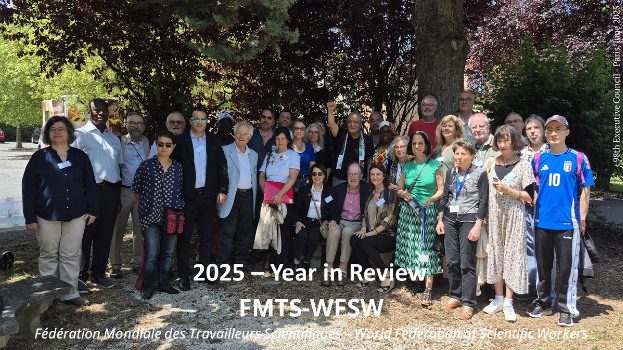
98th Executive Council Meeting of the World Federation of Scientific Workers
Paris, France, June 9–13, 2025
A Contribution to the debate within
Working Group 1: “Peace, Development and Cooperation”
When considering the future of humanity on our planet, two major threats stand out: the risk of nuclear conflict between major powers and the intensification of natural phenomena linked to ongoing climate change and the accompanying ecological disruptions. These two perils undoubtedly represent the gravest dangers facing human societies and the sustainability of life on Earth, at least in its most advanced forms.
It is worth noting that many authoritative and credible sources share this view.
The origins and characteristics of these two threats are fundamentally different, and it is essential to dwell briefly on their nature and genesis.
The emission of greenhouse gases into the atmosphere causes heat to become trapped, leading to global warming and an increase in average surface temperatures on land and at sea. The primary cause of this phenomenon is the burning of fossil fuels – a fact well known to ruling elites, policymakers, the scientific community, and much of the general public.
However, no effective and recognised measures are being implemented to reverse this trajectory and mitigate its disastrous consequences. Reliable statistical data show that the consumption of fossil fuels is increasing steadily year after year, accelerating since the mid-20th century.
The proliferation of extreme weather events attributable to human activity results in significant loss of life and material damage. These events have profound social repercussions, particularly in the poorest countries, where they cause large-scale population displacement. This destabilises geopolitical balances – a central factor in the war–peace dilemma. It should also be emphasised that war, like certain industries and human activities, significantly contributes to the very conditions driving climate change.
Despite this, powerful interests continue to oppose climate mitigation efforts. Ecological disruption – a consequence of climate change – continues unabated: 2023 was the hottest year in at least 174 years. The new watchword is now mitigation, since reversing the current trend is no longer possible – only preventing further deterioration. Among the powerful interests resisting transition are, unsurprisingly, the fossil fuel lobby and the military-industrial complex.
One may then question whether war or climate change – often presented as inevitable consequences of scientific and technological progress – can truly be addressed within the framework of an imperialist globalisation dominated by the dictatorship of big capital. The answer is probably no: big capital needs war and profits from it, particularly through the reconstruction of what war has destroyed. It is not excessive to say that only a revolutionary social transformation could ensure a viable future for life on Earth.
Let us now consider the dangers posed by the existence of a vast nuclear arsenal, particularly in a world where certain leaders irresponsibly contemplate the use of such weapons, whether in Eastern Europe or the Middle East.
The Stockholm International Peace Research Institute (SIPRI), widely regarded as an independent and reliable source, publishes an annual assessment of the global geopolitical situation. In its most recent edition – the SIPRI Yearbook 2024 – the institute’s director, Dan Smith, describes the current moment as follows:
“We are now in one of the most dangerous periods in human history. The sources of instability are countless: political rivalries, economic inequalities, ecological disruption, and an accelerating arms race. The abyss lies before us, and it is time for the major powers to step back and reflect.”
The Yearbook adds:
“Global security continued to deteriorate throughout 2023, as it has for the past decade.”
Indeed, military spending has increased for nine consecutive years. In 2024, it is expected to reach $2.4 trillion USD. The United States accounts for nearly 40% of this figure, followed by China (12%) and the Russian Federation (4.5%).
Both the United States and Russia are conducting extensive nuclear arsenal modernisation programmes – warheads, launch systems, aircraft, submarines, and production infrastructure. The same is true for China, which aims to deploy by the next decade a number of intercontinental ballistic missiles (ICBMs) on alert equivalent to that of the US and Russia. All other nuclear-armed states are developing or announcing new systems.
The United States has approved a 30-year nuclear modernisation programme with an estimated cost of $1.7 trillion. Around 100 tactical nuclear bombs are kept on alert at air bases in Belgium, the Netherlands, Germany, Italy, and Turkey – all under US control.
Keeping nuclear weapons on high alert (“trigger alert”) is a major danger, even in peacetime. Experts warn that it significantly increases the risk of an all-out nuclear war by accident. Alert warheads are mounted on launch systems ready to fire within minutes of a launch order. For example, in a conflict between the US and Russia, it would take only 10 to 30 minutes from launch to impact, depending on the launch site. Submarine launched missiles would reach their targets even faster. Each of the five nuclear powers with permanent seats on the UN Security Council maintains one or more nuclear-armed submarines on continuous patrol, capable of firing from a depth of 50 metres and virtually undetectable.
When an alert is received, a decision must be made very rapidly. In the US and Russia, this responsibility falls to their respective presidents. A technical or software failure could lead to a catastrophic misjudgement. Such situations have occurred in the past. Once launched, a nuclear missile cannot be stopped or diverted. Even if the error were immediately recognised, nothing could prevent the impact. This is why the alert status is so dangerously critical.
It could be said that we are living on a knife’s edge. And one might add that the “responsible adults” seem absent from the decision-making rooms. On the contrary, many appear to have forgotten that “a nuclear war cannot be won and must never be fought,” as repeatedly affirmed by the leaders of the five nuclear powers on the UN Security Council. Yet today, Russia and the United States each keep around 1,700 nuclear warheads on alert.
It is highly unlikely, in our view, that a first strategic nuclear strike could eliminate an adversary’s retaliatory capacity sufficiently to prevent counterattack. This is the basis of the so-called doctrine of Mutual Assured Destruction (MAD). If this logic holds, it may lead nuclear powers to favour conventional wars instead.
Within this framework, proxy wars – such as those observed in Europe – may appear as alternatives to nuclear annihilation. But they are not risk-free: a conventional war between nuclear-armed states could escalate if one side’s existential interests were threatened. This is explicitly stated in the nuclear doctrines of most nuclear powers, with the notable exception of China, which adheres to a “No First Use” (NFU) policy.
Nuclear Armageddon does not serve the interests of large corporations, including the military-industrial complex. In a scorched Earth plunged into a nuclear winter lasting years and devastated by famine, “business as usual” will be nothing more than a memory, as unbearable as our present may already seem.
A word on so-called “tactical” nuclear weapons, often mentioned in recent times.
“Tactical” or “non-strategic” nuclear weapons are mainly distinguished by their explosive yield, ranging from under 1,000 to 100,000 tonnes of TNT equivalent. Strategic weapons, on the other hand, range from 100,000 to several million tonnes – these are thermonuclear or “hydrogen” bombs.
A notable point: as of January 2024, Russia was not keeping its tactical nuclear weapons on alert, unlike the United States, which maintains about 100 such weapons across six European bases.
Some analysts suggest that, in a war between nuclear powers, a tactical nuclear weapon might allow victory in a battle without triggering full-scale war. This is an extremely dangerous idea, as it assumes the enemy would not retaliate with strategic weapons.
Most experts believe it is highly unlikely that the use of a nuclear weapon, even a tactical one, would not trigger an escalation to all-out nuclear war.
It is worth recalling that the Hiroshima bomb dropped in 1945 had a yield of 15,000 tonnes of TNT – and would today be classified as “tactical.” Hiroshima was flattened. The 70,000 immediate deaths represented only one-third of the 200,000 fatalities recorded over the five years following, due to radiation exposure.
The two threats mentioned above – climate change and nuclear war – although naturally distinct, reinforce one another. Notably, the timescale for their global effects is significantly shorter in the case of nuclear war (a matter of months) than for climate change (several decades).
Even a “limited” nuclear war would dramatically worsen climate disruption by sending millions of tonnes of particles into the atmosphere, potentially triggering a “nuclear winter” that would permanently alter climate cycles and jeopardise global food security. Conversely, climate change can itself be a trigger for armed conflict, by intensifying competition over access to vital resources such as water, arable land or energy.
In the face of inertia from international institutions and the complicity of powerful economic and military nations, a global citizen mobilisation is essential. The transformation of the global economic and political system can only come through concerted popular pressure, based on international solidarity, climate justice, and peace.
It is imperative to move beyond a logic of immediate profit and unlimited growth, towards an approach based on the real needs of human societies and respect for planetary boundaries. This requires a fundamental rethinking of our relationship with technology, energy production, armament, and international relations.
The survival of our species and the global ecosystem now depends on our ability to prioritise reason, cooperation, and the common good over domination and exploitation. This demands great political and moral courage, which only an enlightened collective consciousness can enforce.
In truth, it is vital to understand that the two existential threats addressed in this text are not isolated or unpredictable events, but the direct products of an economic and geopolitical system rooted in competition, unrestrained capital accumulation, militarisation, and the extreme brutalisation of international relations – increasingly based on force rather than law. These perils are not natural inevitabilities, but the consequences of a civilizational model that sacrifices the general interest of humanity and life on Earth itself to private gain and power dynamics.
The idea that technology or “green” innovation might save us without structural transformation is a dangerous illusion. Recent history shows that technological advances – from new information and communication technologies, to biotech and artificial intelligence, to autonomous weapons – are today primarily captured by logics of profit, control, and war. Likewise, international agreements on climate or arms limitation, and their accumulation over the years, appear to be nothing more than empty promises if their implementation remains subject to the will of dominant powers, themselves responsible for most emissions and nuclear proliferation.
Lucidity thus demands a clear conclusion: the current conditions of capitalist globalisation are ultimately incompatible with preserving the conditions for life on Earth. Peace, a viable climate, and justice cannot be achieved without a profound upheaval in global social, political, and economic relations. This is not a matter of marginal reform, but of laying the foundations for another way of organising collective life – based on cooperation, frugality, global disarmament, and the sovereignty of peoples over their resources and societal choices.
This entails a determined struggle against the forces that perpetuate and profit from disaster: the fossil fuel lobby, the military-industrial complex, international financial institutions as they currently function, and the governments that dominate or are subjugated by them. This fight can only be waged through massive, transnational civic mobilisation – scientists foremost among them – built around clear objectives: rapid exit from fossil fuels, prohibition of nuclear weapons, demilitarisation of international relations, and the establishment of democratic mechanisms to control major corporations and public investment.
Given the scale of current and potential dangers, inaction and apparent neutrality amount to passive complicity. As scientists, intellectuals, artists, educators, workers, civil society leaders and citizens, we have a duty not only to raise the alarm but to become actively involved in the reforms needed to confront the threats ahead. History will judge us by our capacity to resist the logic of destruction that governs the present, and to build the conditions for a just, peaceful, and viable future for all.
_______________________________
ANNEX TO “NUCLEAR WAR AND CLIMATE CHANGE”
- Nuclear Arsenals and Nuclear-Weapon States Around the World
In 2024, eight countries officially possessed nuclear weapons, with arsenals that varied significantly in both size and sophistication. Only one—the Israeli state—has not officially declared its arsenal, despite being the world’s eighth nuclear power, due to regional strategic considerations. According to estimates by the Stockholm International Peace Research Institute (SIPRI)[1] and the Federation of American Scientists (FAS)[2] , the distribution of nuclear warheads that year was as follows:
| Rank | Country | Estimated Nuclear Warheads | Approximate Share of Global Total |
| 1 | Russia | 5580 | 46% |
| 2 | United States | 5044 | 42% |
| 3 | China | 500 | 4% |
| 4 | France | 290 | 2% |
| 5 | United Kingdom | 225 | 2% |
| 6 | India | 172 | 1.5% |
| 7 | Pakistan | 170 | 1.5% |
| 8 | Israel | 90 | 0.8% |
| 9 | North Korea | 50 | 0.5% |
| TOTAL | 12121 | 100% |
- Russia: With approximately 5,580 warheads, Russia possesses the world’s largest nuclear arsenal. Around 1,710 of these warheads are deployed, with the remainder in reserve or awaiting dismantlement.
- United States of America: The United States has around 5,044 warheads, of which 1,770 are deployed.
- China: China holds approximately 500 nuclear warheads and is heavily investing in the modernisation of its nuclear forces, including the development of intercontinental missiles.
- France: France possesses around 290 warheads.
- United Kingdom: The United Kingdom has about 225 warheads. These two countries maintain a deterrence posture primarily based on submarinelaunched ballistic missile systems (SSBNs).
- India and Pakistan: These two countries have comparable arsenals, with approximately 172 and 170 warheads, respectively. Their long-standing and ongoing rivalry continues to drive the development of their nuclear capabilities. This configuration nearly led them to the use of nuclear weapons in May 2025, following a four-day lightning war triggered by a terrorist attack in April of the same year[3] , which claimed the lives of 26 tourists in Pahalgam, in Indian-administered Kashmir.
- The State of Israel: Although Israel has never officially acknowledged possessing nuclear weapons, experts estimate its arsenal at around 90 warheads.
- North Korea: North Korea is estimated to possess around 50 nuclear warheads[4] , despite its withdrawal from the Treaty on the Non-Proliferation of Nuclear Weapons (NPT) in 2003.
Based on the above data, it is clear that Russia and the United States overwhelmingly dominate the global nuclear landscape, together accounting for approximately 88% of nuclear warheads. The other nuclear powers possess significantly more “modest” arsenals, yet continue to develop and modernise their capabilities. They also pose a considerable threat to global peace, at least within their respective geographical regions, as is the case with India, Pakistan, and Israel.
- What Are the Destructive Capabilities of Global Nuclear Arsenals?
The destructive capabilities of the nuclear arsenals held in 2024 far exceed anything that humanity—and the Earth itself—could endure without experiencing physical and civilizational collapse. To assess their impact, two aspects must be considered:
- Physical Destructive Capacity
- Immediate destruction (per warhead):
– A modern warhead (ranging from 100 to 800 kilotonnes, such as those possessed by the United States or Russia) can instantly annihilate an entire city, for example, Paris, London, Tokyo, Washington, Moscow, or Berlin.
– The explosion produces:
- A massive fireball that vaporises everything within several kilometres;
- A shockwave that flattens all nearby buildings;
- Lethal radiation;
- An electromagnetic pulse (EMP) disrupts all electronic infrastructure.
- Total arsenals:
– The current global total of 12,000 warheads represents many tens of thousands of times the combined power of the Hiroshima and Nagasaki bombs (15–20 kt each).
– The existing arsenal could obliterate all the world’s major urban centres multiple times over.
III. Estimated Costs of Nuclear War
III.1/ Probable Human Costs of the Use of Nuclear Weapons
A regional nuclear war (e.g., India vs Pakistan) involving the use of 100 to 200 warheads could result in:
- 50 to 100 million immediate deaths;
- Global famine triggered by “nuclear winter” (a drop in global temperatures of at least 1 to 2°C, leading to reduced agricultural yields or total collapse of food production across millions of hectares);
- More than 2 billion people affected indirectly—far more than the combined population of the two countries involved, many of whom could die from famine[5] , malnutrition, and the collapse of logistical and humanitarian supply chains.
A total nuclear war (e.g., USA/NATO vs Russia) would cause:
- Between 300 and 600 million immediate deaths within hours;
- Up to 5 billion indirect deaths in the following years, over 60% of the global population as of 2024[6] ;
- The probable collapse of global civilisation, including the disappearance of infrastructure, all civil amenities, current political and organisational systems, and the emergence of unknown sociological and pathological phenomena.
III.2/ Potential Direct Economic Cost of a Nuclear War
Existing studies cannot provide a reliable estimate of the true cost, as one would need to account for both measurable and immeasurable damage, as well as unforeseen consequences in the short, medium, and long term. Furthermore, figures would vary widely depending on the nature of the conflict (its scale, duration, and intensity) and the number of parties involved. However, it can be stated that:
- Direct damages would amount to trillions of dollars in destroyed infrastructure. However, an exact estimate is impossible, as it would involve infrastructure of all kinds (roads, dams, ports, airports, etc.), buildings (residential, industrial, hospitals, schools, universities, cultural and historical sites, etc.), and natural resources (forests, farmland, mineral resources, air, water, etc.). In short, a significant portion of the physical capital (infrastructure and buildings of all kinds) accumulated by humanity would vanish within hours, and countless natural resources on land, underground, and at sea would be permanently or severely damaged for decades.
- Global trade, like most human activity, would come to a near-total halt—on land, at sea, and in the air. All stock exchanges would cease to function for prolonged periods; existing currencies would become worthless, as there would be almost nothing left to buy or sell; the global financial system would collapse, and financial markets would crash for an extended period.
- The global economy would revert to a prehistoric subsistence state. In a situation where the world’s major powers have been destroyed by war, none would be able to revive the global economic system, unlike what occurred after 1945 with the United States of America, or to a lesser extent, with the Soviet Union and China.
Mehdi Lahlou & Frederico Carvalho
June 8, 2025
____________________________________________
Graphic Composition: OTC, Portugal
Portuguese version: https://otc.pt/wp/2025/07/29/guerra-nuclear-e-alteracoes-climaticas/
__________________________________________
[1] SIPRI Yearbook 2024: Global nuclear arsenal growth raises concerns. https://www.aa.com.tr/en/world-cup2018/sipri-yearbook-2024-global-nuclear-arsenal-growth-raises-concerns/3252134
[2] Federation of American Scientists: Nuclear Information Project.
https://nuclearweapons.info/organization/nuclear-information-project-fas/
[3] Le Monde, journal de France, ‘’Inde-Pakistan : quatre jours de guerre, deux versions des combats, et toujours
aucun gagnant’’. https://www.lemonde.fr/international/article/2025/05/23/conflit-inde-pakistan-quatre-jours-deguerre-deux-versions-des-combats-et-toujours-aucun-gagnant_6607952_3210.html
[4] The Centre for Strategic and International Studies (CSIS). https://www.csis.org/
[5]. ‘’Global food insecurity and famine from reduced crop, marine fishery and livestock production due to climate disruption from nuclear war soot injection’’. 15 August 2022.
https://www.nature.com/articles/s43016-022-00573-0
[6] Idem