Presidence report – 98th EC WFSW
Presidence report
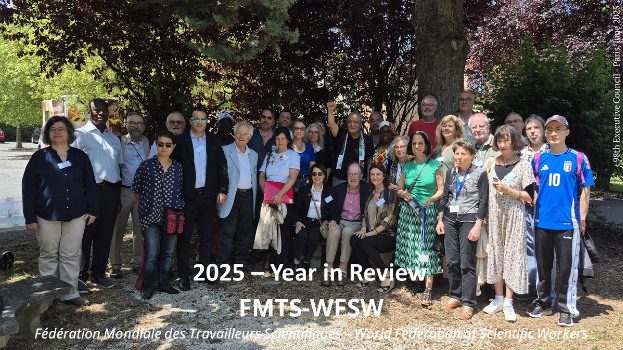
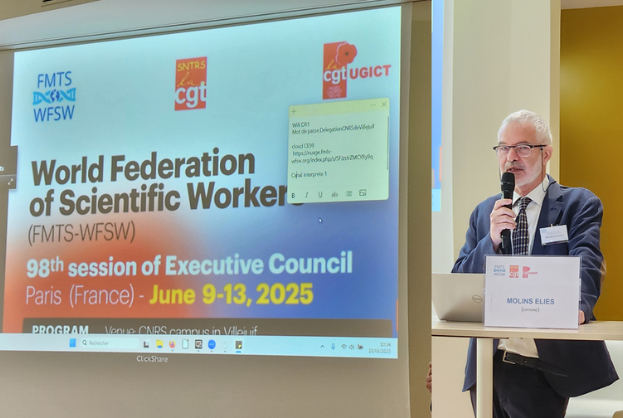
98th Executive Council Meeting of the World Federation of Scientific Workers
Paris, France, June 9–13, 2025
WFSW activity
First of all, we must celebrate the recovery of Jean-Paul after his surgery, and also his presence here today, accompanied by his wife. After our most recent Executive Councils in China and Morocco, we are now returning to our headquarters in Paris, just as we mark the 125th anniversary of the birth of our founder, Frédéric Joliot-Curie (1900—1958), who was married to Iréne Curie.
In 2026, the Federation will celebrate its 80th anniversary, and we must organize the statutory 24th General Assembly, which, interestingly, will coincide with the 100th Executive Council. On this occasion, we plan to meet somewhere in the Americas, most likely in connection with the CILAC 2026 meeting, as suggested by UNESCO, in order to benefit from their support.
Over the past year, several important activities have taken place. Soon after our last EC, the Symposium on Open Science in the Arab countries, held in Rabat, proved to be a success, with participation from representatives of nearly all relevant nations. We are even considering a second edition. The International Secretariat has met regularly on the first Monday of every month, while the Bureau, which prepares the meetings and reviews decisions, has gathered at least twice a month.
We have strengthened our contacts with UNESCO, including meetings in February with Ana Persic and Sabrina Colombo. Our Communication sector has made commendable efforts to keep the website updated and to enrich our social media content. I encourage you to watch the video on plastic pollution and the impressive summary of the hydrology project in Africa, a highly successful WFSW initiative in partnership with UNESCO. We should also highlight our ongoing collaboration with UNESCO’s Link/Lien journal. Thanks to André Jaeglé and the UNESCO team, we have established agreements to cooperate with two organizations in Chad— details of which will be presented in the second session of this EC.
In February, we also met representatives of all the French AOs: Agathe Le Berder (UGICT), Anne Roger, Michel Maric, Patrick Boumier, Claudine Gallina (SNESUP-SNTRS), and Boris Gralak (SNCS). The SNCS has paused its membership, although it wishes to maintain a relationship with WFSW as an observer. Some of us also attended UNESCO’s two-day conference on Science Diplomacy, chaired by Lidia Brito.
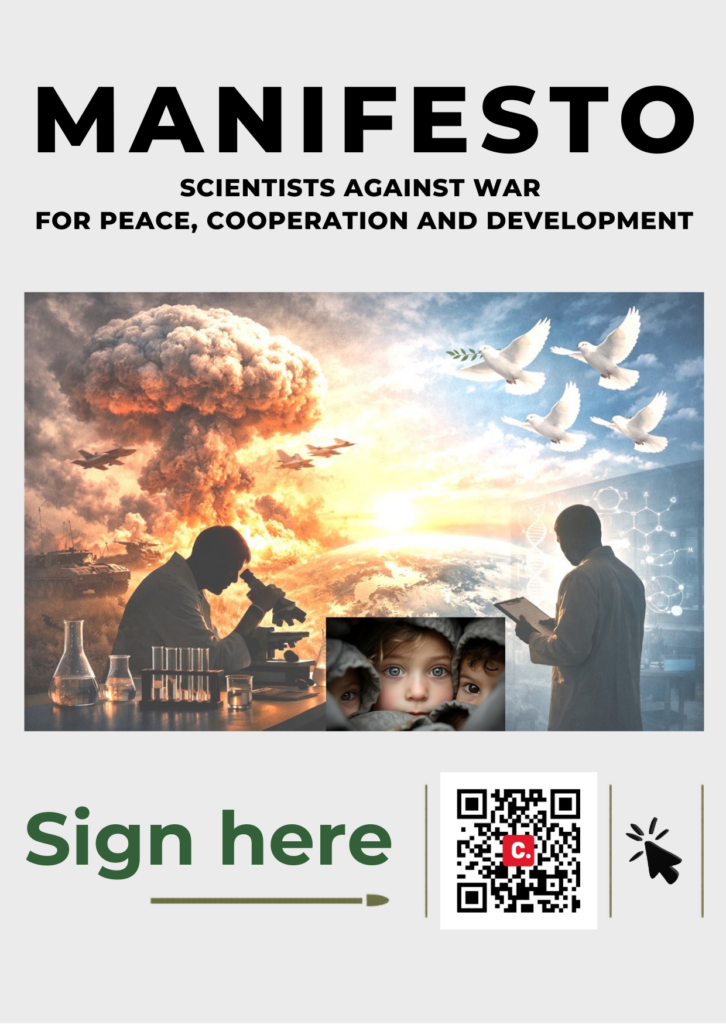
We continue our engagement with AOs abroad: Jean-Paul attended the 15th Congress of FENPROF in Lisbon, while Jamal participated in the SNESUP congress in Angers. Our appeal for peace was finally issued, along with our endorsement of the Stand for Science initiative.
Most working groups have been active, except WG4, WG5, and WG8, which need to be reactivated. WG7 is also progressing and will present its work and plans. A new list of Individual Members has recently been created in an effort to involve them more actively in Federation activities and in the work of the WGs. Notably, WG6 has drafted a revised Internal Regulation, to be discussed during this EC, along with possible amendments to the Statutes.
We are pleased to welcome a new member organization: The Association of Women Scientists from Ivory Coast, represented by Scherezade Fatou, who will introduce her association in the 4th session. We also welcome the presence of Gülez Evrim from EGITIM-SEN (Turkey) as an observer.
Finally, we must turn to the Federation’s difficult financial situation and determine the course of action for the near future.
Current Perspective
As I have emphasized in recent years, the aims of the WFSW are more relevant than ever. At its origin, the central challenge was the very existence of nuclear weapons. Fortunately, progress in science and technology, supported by progressive governments, led to significant improvements in quality of life—primarily in Europe and the Americas, and later in Asia. Africa, however, has benefited least from these advances.
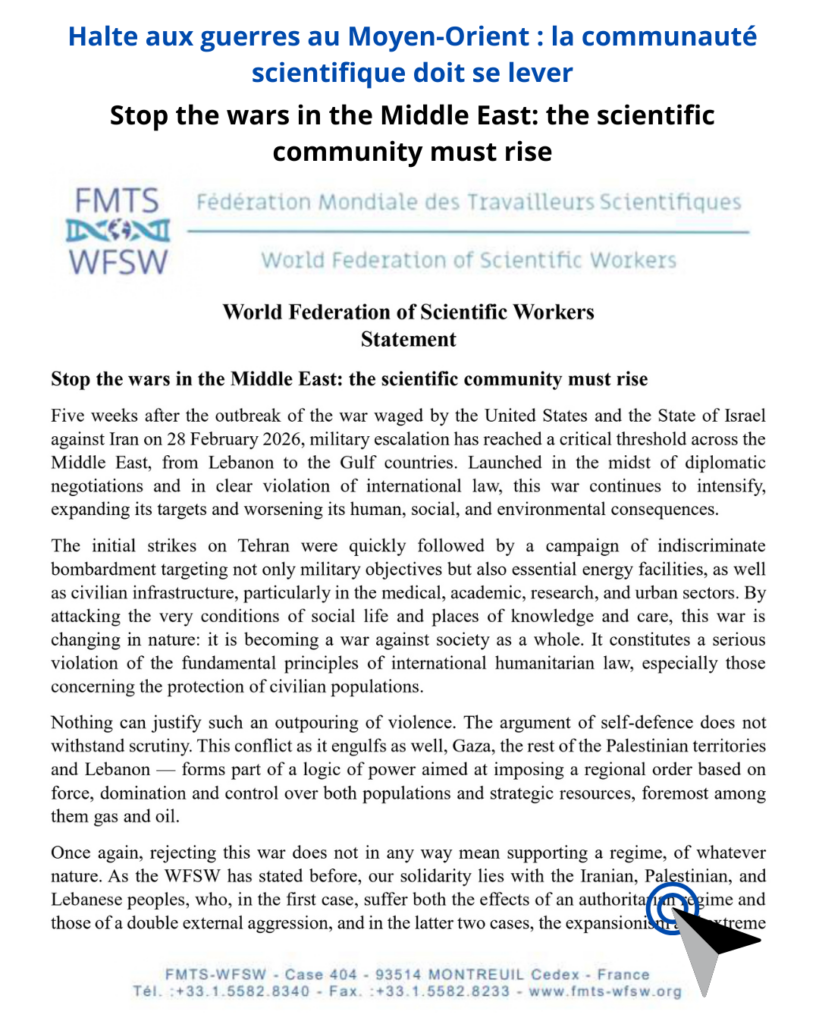
The progress achieved by the end of the 20th century raised new problems, now addressed by UNESCO’s Sustainable Development Goals. Eliminating war should have been one of the defining objectives of the 21st century. Wars must never be an option: their outcomes are invariably catastrophic, especially given today’s destructive technologies. The declaration put forward by groups 1, 2, and 3 highlights the risks posed by the enormous destructive power held by armies worldwide. Artificial intelligence, cyberattacks, and new generations of drones— such as swarms that resemble clouds of insects—are innovations against which no one can be fully protected. As recent events have shown, even strategic bombers deep within Siberia can be destroyed by drones.
The ongoing conflict in Palestine is a case of complete irrationality, and I believe we all share responsibility for failing to stop it. A people who endured the Holocaust are now inflicting hunger and suffering on another. Words fail me. Alongside the wars in Ukraine and Palestine, many other conflicts remain active—Sudan, Syria, the Democratic Republic of Congo, Myanmar, Mali, Haiti, and more. Each drains resources that humanity urgently needs to confront climate change, which I believe is our greatest challenge today.
A world population approaching 10 billion, consuming resources at exponential rates, is exhausting the planet’s reserves and destabilizing the biosphere. You may recall Mariano Marzo’s conference in Barcelona on the Anthropocene: once we spoke of pollution and the ozone hole, but now we face the melting of glaciers and permafrost, shifting species distributions, collapsing biodiversity, more frequent extreme weather events, intensifying droughts and floods, increasingly powerful hurricanes, and an average global temperature already 1.7 °C higher than before.
These issues will be further addressed in Antonio Turiel’s keynote lecture on Thursday, and during the symposium’s round tables. Not only are fossil fuels (oil, natural gas, diesel) already in decline—compromising industry, transport, and agriculture—but 14 key elements of the periodic table are becoming scarce, including copper, silver, and uranium. Nuclear reactors are now resorting to uranium from military stockpiles.
Awareness of the crisis is spreading (a success of the scientific community), even among the reluctant. Yet the full scale of the risk is still underappreciated. As reported by WG2 (Marc Delepouve, Xiqiu Han, and Josette Rome-Chastanet), numerous hidden, potentially catastrophic effects remain poorly understood—such as underground fires in Siberia, disruptions in ocean circulation, or the release of methane clathrates from the deep sea.
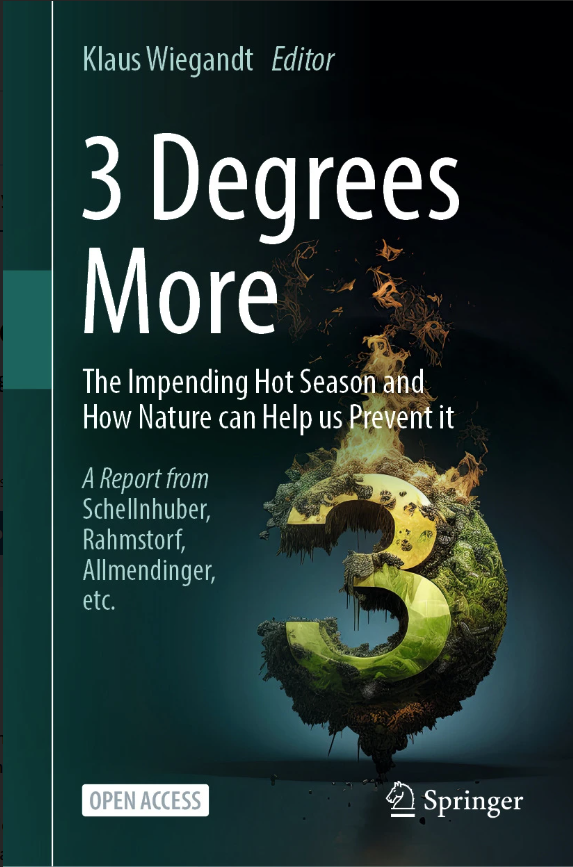
This is the scientific diagnosis of our present situation. Unless we fundamentally change the rules of our civilization—from everyday domestic life to the strategies of governments and corporations—we are on course for a 3 °C temperature increase by 2060. The catastrophic consequences are outlined in 3 Degrees More (Springer, open access), which we promote on our website. Vast regions at lower latitudes and coastal areas will become uninhabitable. The risk of revolutionary upheaval is real.
Several scenarios lie ahead. The best—global cooperation against the Anthropocene crisis—is nearly out of reach. The most probable outcome is minimal, uncoordinated changes, implemented only in response to catastrophic events.
Why? Because of a chain of misguided decisions. Capitalism proved efficient at generating wealth and rapid growth, but at the cost of equity and fairness. The necessary shift has not been made, and the wealthy continue to prioritize their own survival, failing to understand that isolation is impossible in a planetary crisis. To maintain control, decision-makers have seized mass media and manipulate public opinion. As a result, many young people follow false prophets offering absurd solutions. Examples include the demonization of immigration and taxation. Yet immigration increases workforce and productivity, while taxation ensures equity by sustaining public services like healthcare and education. Without them, only the rich would have access.
We are on the wrong path when we allow ourselves to be misled by populist discourse, when we undermine international organizations like the WHO, when we prioritize competition over cooperation, and—most dangerously—when we increase military spending. Perhaps governments are preparing for the “climate revolution,” which may already be beginning, as suggested by the Los Angeles protests just few days ago.
The role of WFSW, and of its AOs, is to raise awareness of the profound challenges we face— climatic, social, and political—and to transmit reliable, evidence-based information in order to counter populism and disinformation. Science is often discredited because it reflects reality, while fake news manipulates and misleads, ultimately weakening democracy.
The only way forward is to ensure that the majority of the population understands the true situation and forces decision-makers to act in the common interest. Earth is our only ship, and the Great Flood has already begun.
Elies Molins — June 2025
_______________________________________
Graphic composition: OTC, Portugal
Portuguese version: https://otc.pt/wp/2025/10/14/fmtc-ce98-paris-2025/